
You might be wondering what this term, air change rate vol/h, means. It’s an important measure for understanding how air circulates in your home. Essentially, it tells you how many times the air in your dwelling is completely replaced by fresh air each hour. It’s a bit like knowing how fast your house breathes. We’ll look at this in more detail, how it’s calculated, and why it’s good to be interested in it.
Key takeaways
- The air change rate, expressed in volumes per hour (vol/h), indicates how often the indoor air of a building is exchanged with outdoor air.
- Good air tightness is essential for controlling this renewal, as unwanted infiltration can cause discomfort, mould, and excessive energy consumption.
- Air tightness tests, such as the blower door test, allow for the measurement of air leakage flow rate and the deduction of the air change rate.
- Ventilation systems, particularly mechanical ventilation (VMC), play a direct role in managing air renewal, ensuring controlled indoor air quality.
- Various factors such as temperature, wind, building design, and the use of ventilation systems influence the air change rate, which can vary over time.
Understanding the air change rate vol/h
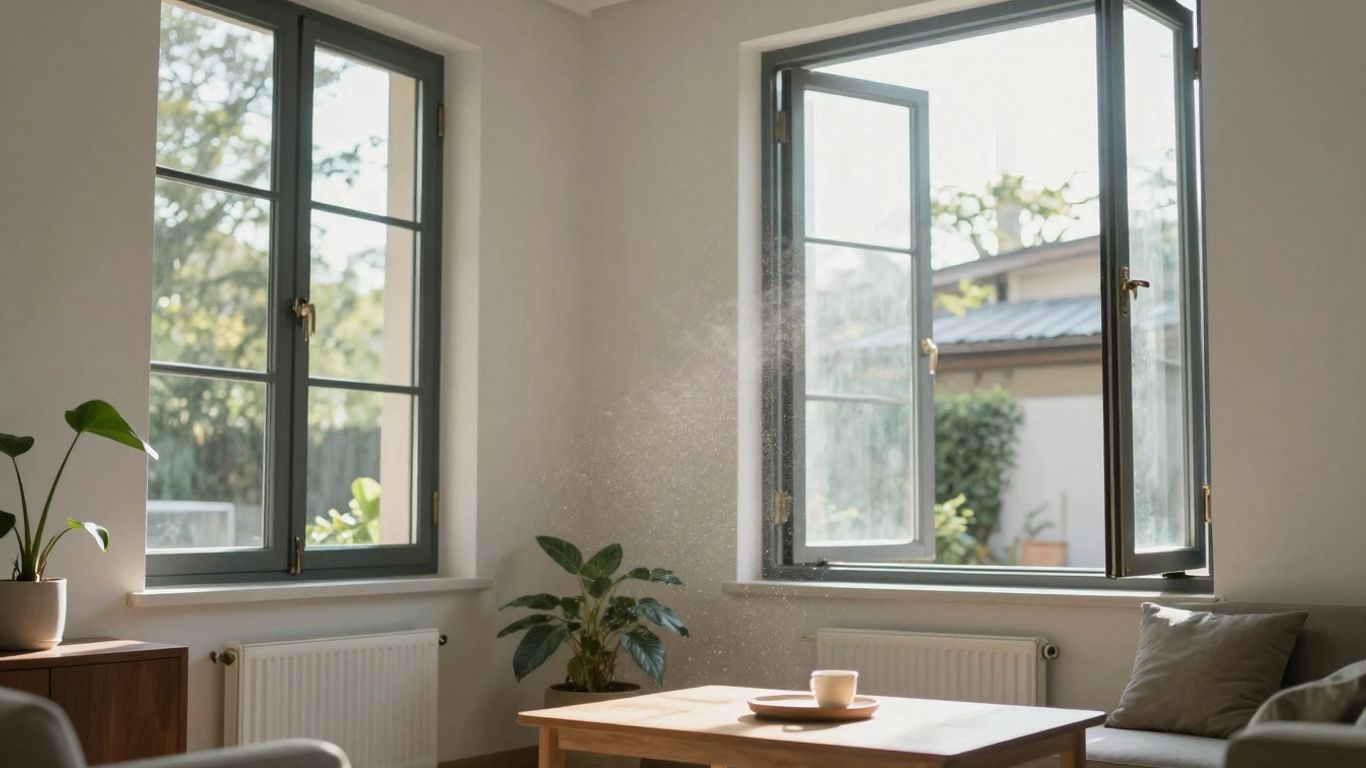
The air change rate, often expressed in volumes per hour (vol/h), is a key measure for assessing indoor air quality and a building’s energy efficiency. It represents the number of times the air contained within a given volume is replaced by outdoor air in one hour. Understanding this rate is therefore essential for ensuring a healthy and comfortable environment.
Definition and importance of air tightness
A building’s air tightness refers to its ability to limit uncontrolled air ingress and egress. These unwanted air flows, known as infiltration, occur through defects in the building envelope: cracks, poorly fitted joints, or non-airtight cable or pipe penetrations. Good air tightness is fundamental to controlling air exchange. It helps reduce heat loss in winter and heat gain in summer, thus contributing to better energy performance. Without an airtight envelope, even an efficient ventilation system can have its effectiveness compromised.
Impact of infiltration on comfort and energy consumption
Air infiltration has direct consequences on your daily life and your wallet. In winter, cold air infiltration can create unpleasant draughts, lowering the indoor temperature and making certain rooms uncomfortable, even when the heating is on. This can lead to excessive energy consumption as the heating system has to compensate for these constant losses. In summer, conversely, hot and humid outdoor air can enter, increasing the air conditioning load. Furthermore, the moisture that accompanies these infiltrations can promote mould growth and degrade indoor air quality.
Factors influencing natural air renewal
A building’s natural air renewal is influenced by several factors. The temperature difference between the inside and outside, known as stack effect, plays an important role: warm air, being lighter, tends to rise and escape through the top of the building, creating an air intake at the bottom. Wind also exerts pressure on the facades, promoting air entry or exit depending on its direction. The overall permeability of the building envelope, i.e., the ease with which air can pass through it, is a determining factor. Finally, the presence of a basement or crawl space can alter air flows beneath the building.
Here are some elements that influence natural air renewal:
- Temperature difference: The greater the difference between inside and outside, the stronger the stack effect.
- Wind strength and direction: Wind can significantly increase air exchange, especially if the building is not very airtight.
- Building design: The presence of chimneys, ducts, or ceiling height can affect air movement.
- Opening of windows and doors: Although controlled, natural ventilation by opening windows and doors increases air renewal.
Methodology for calculating air renewal

To properly understand your building’s air change rate, precise measurements are needed. You can’t just guess; you need concrete figures.
Principles of air tightness testing
Air tightness testing, or infiltrométrie, is the benchmark method for assessing a building’s air tightness. A machine called a ‘blower door’ is used, which creates a pressure difference between the inside and outside of the building. By measuring the airflow required to maintain this pressure, air leaks can be quantified. It’s a bit like measuring your house’s ‘breathing’. Tests are generally carried out under specific conditions, often at a pressure of 50 Pascals (Pa), as this is a value that allows for comparison of results between different buildings. This measurement is a key step in understanding your home’s energy performance.
Interpreting measurement results
Once the test is done, you need to know how to read the figures. The main result is the leakage rate at 50 Pa, expressed in m³/h/m² of developed surface. This figure tells us how much air your building lets through. The lower it is, the better. It’s worth noting that several measurement campaigns may be necessary, especially if you want to assess the seasonal variability of gas transfer. For example, some standards recommend at least two, or even three, measurement campaigns to get a more accurate picture. Climatic conditions, such as temperature and wind, play a role, and it’s good to note them.
Relationship between leakage rate and air change rate
The leakage rate measured during air tightness testing is not directly the air change rate (vol/h). A conversion is necessary. The air change rate is the volume of air exchanged in the building per hour, relative to the total volume of the building. Formulas are used that take into account the leakage rate, the internal volume, and the pressure difference. It is important to note that natural air renewal depends on several factors:
- The temperature difference between inside and outside (stack effect).
- The strength and direction of the wind.
- The overall permeability of the building.
Understanding these interactions is essential for accurately assessing natural air renewal and identifying potential sources of unwanted infiltration that can affect comfort and energy consumption.
Role of ventilation systems
Operation of controlled mechanical ventilation (VMC)
Controlled mechanical ventilation (VMC) systems play a direct and often predominant role in renewing the air in your home. Unlike natural ventilation, which depends on weather conditions and your habits (opening windows), VMC ensures a constant and controlled airflow. There are mainly two types of VMC that influence the air change rate in different ways.
Advantages of double-flow VMC
Double-flow VMC goes further than simply extracting or supplying air. It combines both: it extracts stale air from your home while supplying fresh outdoor air. One of its major advantages lies in its heat exchanger. This device recovers some of the heat from the extracted air to preheat the incoming fresh air before it enters your rooms. This allows for air renewal without excessive heat loss, which is a considerable advantage for your comfort and heating bill. Furthermore, by adjusting the flow rates, it is possible to create a slight positive pressure in the dwelling, which can help limit unwanted air infiltration from outside or the ground.
Influence of systems on air change rate
The type of ventilation system installed in your building directly influences the air change rate, measured in volumes per hour (vol/h). Here’s how different systems compare:
- Natural Ventilation: This system relies on pressure differences (stack effect, wind) and openings (vents, windows). Its flow rate is highly variable and difficult to predict. It may be sufficient in some cases, but it is often insufficient to guarantee good indoor air quality in more airtight modern constructions.
- Single-flow VMC (Extraction): It mechanically extracts stale air and allows outdoor air to enter through dedicated air inlets (often in window frames). It creates a slight negative pressure in the dwelling. Air renewal is more constant than with natural ventilation, but the incoming air is not preheated, which can lead to heat loss.
- Single-flow VMC (Supply): Less common, it supplies fresh air and stale air is naturally expelled through outlets. It can create a slight positive pressure.
- Double-flow VMC: As mentioned, it extracts and supplies air, with heat recovery. This system offers the most precise control over air renewal while optimising energy performance.
The choice and correct adjustment of your ventilation system are therefore crucial for achieving the desired air change rate, thereby ensuring both indoor air quality and the energy efficiency of your building.
Parameters influencing the air change rate
The air change rate in a building is not a fixed value. It is the result of a complex interaction between several factors, some related to the construction itself, others to its external environment. Understanding these influences helps you better control your home’s indoor air quality and energy efficiency.
Effects of temperature and wind
The temperature difference between the inside and outside, known as the stack effect, plays a significant role. When it’s cold outside and warm inside, warm air tends to rise and escape through the top of the building, while cold air infiltrates from the bottom. This natural phenomenon contributes to air renewal. However, when temperature differences are small (less than 5°C), this effect becomes less pronounced. This is where wind comes into play. Even a light breeze can create pressure differences on the building’s facades, forcing air to enter or exit through openings and air leaks. The interaction between the stack effect and wind is therefore an important driver of natural air renewal.
It’s important to know that these effects are not always easy to predict. They depend heavily on how the building is constructed and its permeability. For example, a well-sealed house will be less sensitive to wind variations than an older, more porous house. Weather conditions, such as an anticyclonic (high pressure) or cyclonic (low pressure) period, can also alter how ground gases interact with indoor air, indirectly influencing air renewal.
Impact of building permeability
Your building’s air permeability is a determining factor. It corresponds to the ease with which air can pass through the building envelope. Low permeability means that air circulates little, which is generally desirable to limit heat loss and unwanted infiltration. Conversely, high permeability, due to, for example, worn window seals, cracks in walls, or poor insulation, leads to greater, but often uncontrolled, air renewal. This excessive renewal can cause discomfort, energy waste, and promote mould growth. The goal for a high-performance renovated house is often to achieve a low air change rate, for example, less than 1 vol/h at 50 Pascals, as suggested by some standards [6954].
The presence of basements or crawl spaces can also influence permeability and air exchange. A ventilated crawl space can act as a barrier, while buried rooms increase the potential surface area for vapour ingress. The construction materials themselves, such as rammed earth or porous walls, facilitate gas intrusion. It is therefore essential to consider the overall design of the building and its foundations to assess its behaviour regarding air exchange.
Seasonal and temporal variability of concentrations
Indoor air pollutant concentrations are not constant. They vary over time, influenced by weather conditions (temperature, wind, pressure, rain) and occupant habits (heating, ventilation). This variability is particularly marked when there is soil or groundwater pollution nearby. For example, a single measurement of formaldehyde concentration can have a very high uncertainty (up to 78%), while repeated measurements reduce this uncertainty (around 25% with two samples). It is therefore important not to rely on a single measurement to assess air quality.
Atmospheric pressure variations, for example, can alter how ground gases migrate into a building. A drop in pressure can promote this migration, while an increase can limit it. The time it takes for soils to react to these pressure changes varies depending on their permeability and depth, creating a time lag between atmospheric pressure changes and their effect on ground gases.
It is therefore recommended to take multiple measurements at different times to get a more accurate picture of your home’s air quality and actual air renewal. This approach allows for a better understanding of the dynamics involved and for adapting ventilation strategies accordingly.
Benchmarks and standards for air renewal
To properly assess and manage your building’s air renewal, it is useful to be aware of the current standards and regulations. These benchmarks help you understand what is considered good performance and what the legal requirements are.
Energy performance criteria
A building’s air tightness is a key indicator of its energy performance. Standards such as those related to the BBC Effinergie label define precise thresholds. For example, a Q4Pa-surf value below 1.3 m³/h/m² is often cited as a benchmark. Good air tightness limits heat loss and reduces heating consumption. Uncontrolled air infiltration can cause discomfort, soiling, mould, noise nuisance, and excessive energy consumption. It is therefore important to aim for high levels of air tightness for optimal comfort and controlled energy bills.
Regulatory requirements for indoor air quality
Indoor air quality (IAQ) is a major concern, especially in public places. Regulations require regular checks in certain buildings. For example, Article L221-8 of the Environmental Code Article L221-8 of the Environmental Code stipulates the monitoring of IAQ in specific Public Access Buildings (ERP). These checks aim to ensure that pollutant levels remain within acceptable limits for the health of occupants. Measurements often need to be taken at different times of the year to account for the variability of concentrations.
Best practices for assessing gas transfer
To correctly assess gas transfer, particularly from the ground, several measurement campaigns are generally recommended. It is often advised to carry out at least two campaigns per year, ideally during contrasting periods (e.g., a cold period and a milder period). This allows for a better understanding of the seasonal variability of concentrations. The choice of sampling points is also important: priority should be given to areas representative of occupancy and areas potentially disturbed by specific activities or particular construction elements that could skew the results. It is also relevant to take samples in basements or crawl spaces to better understand potential flows.
Conclusion on air change rate
So, we’ve covered what you need to know about the air change rate, or vol/h. You’ve seen how to calculate it and why it’s important to manage it well. Good air tightness prevents unpleasant draughts, limits soiling and mould, and also helps avoid wasting energy on heating. Remember that conditions change, and wind or temperature differences can play a role. Therefore, you need to stay aware of these factors. If you have any doubts, don’t hesitate to consult the guides and standards available to help you make the right choices for your home. It’s an often-overlooked aspect, but it has a real impact on your comfort and your consumption.
Frequently Asked Questions
What is the air change rate and why is it important?
The air change rate, often expressed in ‘volumes per hour’ (vol/h), measures how often all the air in a room or building is replaced by fresh outdoor air. It is a key indicator for indoor air quality. Good air renewal helps remove pollutants, moisture, and unpleasant odours, thus contributing to a healthier and more comfortable environment. Without sufficient renewal, you risk problems such as condensation, mould, or a feeling of thermal discomfort, especially in winter when the air can become cold and stale.
How is the air renewal of a home measured?
To accurately determine the air renewal rate, a test called ‘air tightness testing’ is used, often carried out with a ‘blower door’. This device creates a pressure difference between the inside and outside of the building. By measuring the airflow entering or exiting through leaks (the ‘infiltrations’), the air change rate can be calculated. It is a fairly reliable method for assessing the air tightness of your house or flat.
What is VMC and what is its role in air renewal?
VMC, or Controlled Mechanical Ventilation, is a system that helps renew the air in your home in a more controlled way than simple ventilation. There are different types, such as single-flow VMC which extracts stale air, and double-flow VMC which, in addition to extracting air, reintroduces fresh air while recovering some of the heat from the outgoing air. These systems play an essential role in ensuring constant and efficient air renewal, thereby improving indoor air quality and comfort.
What can influence the amount of air that is renewed in my house?
Several factors can affect air renewal. Wind, for example, can push air through small openings. The temperature difference between inside and outside, known as ‘stack effect’, also plays a role, especially in winter. How your house is built, particularly its permeability (how easily air passes through it), is also very important. Even the seasons and the time of day can alter these air exchanges.
Are there any standards or recommendations for air renewal?
Yes, there are rules and best practices. Regulations, such as those related to building energy performance (e.g., the BBC Effinergie label), set limits for air tightness. There are also requirements to ensure good indoor air quality, as air that is too frequently renewed can also cause heat loss, and air that is not renewed enough can be bad for health. The idea is to find the right balance.
Why is it important for my house to be well sealed against air?
Good air tightness is crucial for several reasons. Firstly, it prevents unpleasant draughts that can make your home uncomfortable, especially when it’s cold and windy. Secondly, it helps prevent mould and soiling on walls, as it limits cold spots where moisture can condense. Finally, and very importantly, a well-sealed house allows for better control of your heating energy consumption, as it prevents heat from escaping unnecessarily through air leaks.
