
Are you wondering how a scroll compressor works and what its advantages are? This article will shed light on this technology, which is increasingly present in our heating and air conditioning systems. We will break down its operating principle, its major benefits, and how it compares to other types of compressors. Get ready to understand the scroll compressor’s operation in detail.
Key Takeaways
- The scroll compressor uses two intermeshing scrolls to compress refrigerant fluid continuously and without vibration.
- Its quiet operation and high energy efficiency make it an ideal choice for residential applications.
- Thanks to its simple mechanics, it offers increased longevity compared to other technologies.
- It is particularly efficient when combined with Inverter technology for precise speed regulation.
- While excellent for comfort and efficiency, it is less suited for very high-pressure industrial applications than screw or piston compressors.
Understanding How a Scroll Compressor Works
The compressor is a key component in many air conditioning and heating systems, acting as the heart of the installation. Among the various technologies available, the scroll compressor stands out for its unique approach to fluid compression. It is essential to grasp its operating principle to appreciate its many benefits.
The Principle of Scroll Operation
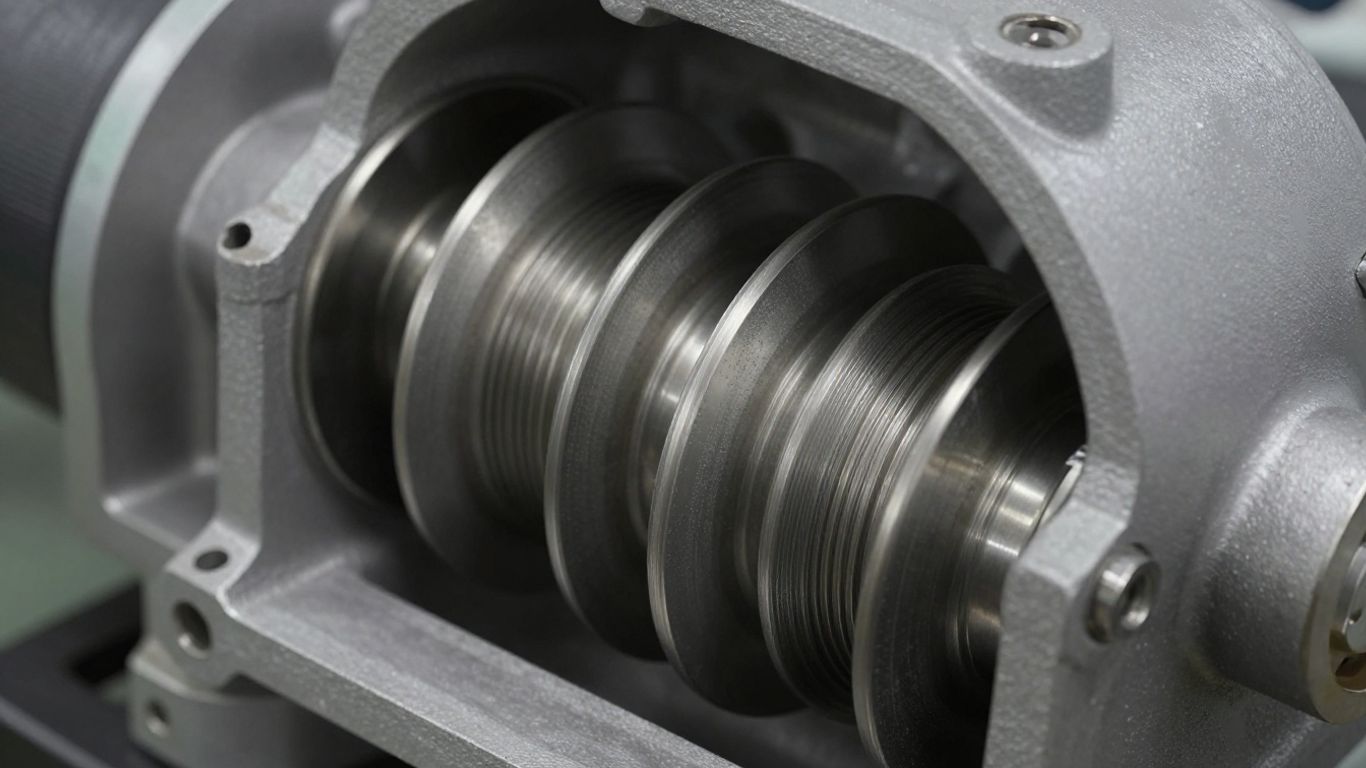
At the core of the scroll compressor are two intermeshing Archimedean scrolls. One of these scrolls is fixed, while the other performs an eccentric orbital motion, without rotating on its own axis. This particular movement creates pockets of gas between the two scrolls. As the orbiting scroll moves, these pockets migrate towards the centre, progressively reducing in volume. It is this gradual reduction in volume that compresses the refrigerant fluid. This continuous, smooth motion is the key to its efficiency and quiet operation. Unlike piston compressors, there are no valves or reciprocating parts, which greatly simplifies the mechanics.
Smooth and Vibration-Free Compression
One of the most notable advantages of the scroll compressor is its ability to provide smooth and virtually vibration-free compression. The orbital motion of the orbiting scroll ensures continuous expansion and compression of the gas. This eliminates the shocks and pulsations typical of reciprocating compressors. This absence of vibration results in smoother operation and reduced mechanical wear. This is a considerable advantage, especially in residential applications where acoustic comfort is paramount. You can learn more about the role of the compressor in an installation here.
Simple and Durable Mechanics
The design of the scroll compressor is remarkably simple. It relies on a limited number of moving parts: the two scrolls and a drive motor. This mechanical simplicity has several positive consequences. Firstly, it reduces potential failure points, contributing to better reliability. Secondly, it simplifies maintenance and reduces the risk of leaks. The robustness of this design, combined with the absence of wear parts like piston rings, gives the scroll compressor increased longevity compared to other technologies. Its design makes it particularly suitable for systems that require speed adaptation, such as those using Inverter technology.
Key Advantages of the Scroll Compressor
Quietness and Acoustic Comfort
One of the first things you’ll notice with a system equipped with a scroll compressor is its remarkably quiet operation. Unlike other technologies that can generate perceptible noise and vibrations, the scroll compressor operates with a smoothness that greatly minimises noise nuisance. This discretion is particularly appreciated in residential or office environments, where quietness is an important comfort factor. You benefit from efficient air conditioning or heating without being disturbed by the equipment’s noise.
Optimised Energy Efficiency
The intrinsic design of the scroll compressor contributes to better energy efficiency. The continuous movement of the scrolls allows for smoother and more regular compression of the refrigerant fluid. This translates into reduced energy consumption compared to older technologies, such as piston compressors, which can have efficiency losses due to more jerky movements. The use of Inverter technology with scroll compressors allows for precise adjustment of the delivered power according to actual demand, thus avoiding constant on/off cycles and optimising electricity consumption. This can result in significant savings on your energy bills.
Increased Longevity
The mechanical simplicity of the scroll compressor is a major asset for its durability. With fewer moving parts compared to other types of compressors, there are fewer points of friction and potential wear. This robust design, combined with smoother compression that reduces stress on components, gives the scroll compressor a generally longer lifespan. Fewer parts also mean fewer potential mechanical failures, ensuring peace of mind in the long run.
The low-vibration operation and progressive compression limit wear on internal components, which is a determining factor for the device’s longevity. This increased reliability reduces the frequency of maintenance interventions and the need for premature replacements.
Applications of the Scroll Compressor
The scroll compressor, thanks to its unique characteristics, finds its place in a variety of applications where reliability, quietness, and efficiency are paramount. You will find it notably in heating and air conditioning systems, but its benefits open other doors.
Residential Heat Pumps
This is undoubtedly the area where the scroll compressor has made the biggest impact. In homes, acoustic comfort is a priority. The smooth, vibration-free operation of the scroll makes it ideal for both indoor and outdoor units of heat pumps. It helps maintain a peaceful environment while ensuring efficient heating or cooling. Many manufacturers, such as LG, offer scroll compressors specifically designed for these residential applications, guaranteeing performance tailored to household needs. Its ability to operate continuously and modulate its power, especially with Inverter technology, makes it a preferred choice for optimising energy consumption.
Air Conditioning Systems
Beyond heat pumps, air conditioning systems, whether for individuals or small to medium-sized commercial buildings, greatly benefit from scroll technology. Its simple design, with few moving parts, reduces the risk of breakdowns and facilitates maintenance. This translates into increased reliability and reduced long-term operating costs. Scroll compressors are capable of handling frequent operating cycles without premature wear, which is common in air conditioning systems. Brands like Copeland offer robust models for these uses, often optimised for different types of refrigerants.
Other Uses
Although less publicised, the scroll compressor can also be used in other contexts. It can be found in some commercial refrigeration applications where noise level is an important factor, such as in small cold rooms or refrigerated display cases. Its ability to provide smooth and constant compression is an advantage. It is also considered for small compressed air production systems where noise is a constraint. Its versatility makes it interesting for bespoke solutions, far from heavy industrial applications that often prefer other more robust technologies for extreme pressures.
The Scroll Compressor Versus Other Technologies
When choosing a compression solution, it is useful to know how the scroll compressor compares to its counterparts. Each technology has its strengths and weaknesses, and understanding these differences will help you make the best choice for your needs.
Comparison with Piston Compressors
Piston compressors, often considered veterans in the field, operate using the reciprocating motion of pistons in cylinders. They are recognised for their robustness and ability to handle high pressures. However, their main drawback lies in their noisier operation and the vibrations they generate. Furthermore, their mechanics, while solid, can be more complex and require more frequent maintenance to maintain optimal performance. In comparison, the scroll compressor offers smoother compression, without the characteristic pulsations of piston systems, resulting in significantly quieter operation and less vibration. This is a considerable advantage, especially in residential applications or where acoustic comfort is a priority. While piston compressors can be an economical option for some applications, their energy efficiency may be slightly lower than that of modern scroll compressors, especially at partial load.
Differences with Screw Compressors
Screw compressors are generally reserved for large-scale industrial applications. They use two helical rotors that mesh to compress the fluid. Their main advantage is their ability to provide high airflow and continuous operation, making them ideal for installations that run 24/7. They are also known for their durability under intensive use. However, their size and cost are often greater than those of scroll compressors. The scroll compressor, on the other hand, excels in its compactness and efficiency in smaller to medium power ranges. It offers smoother compression and less energy loss, which can translate into better overall energy efficiency for residential or light commercial systems. If you are looking for a solution for very large industrial installations, a screw compressor might be more suitable, but for most air conditioning and heating applications, the scroll offers a better balance. You can find information on different types of compressors to better understand their uses.
Positioning Relative to Rotary Vane Compressors
Rotary vane compressors represent another interesting technology. They are appreciated for their mechanical simplicity, quiet operation, and ability to provide a steady airflow, without the pulsations of piston compressors. They are often used in applications where noise is a concern, such as in dental clinics or workshops. Their compact design is also an advantage. However, they generally have limitations in terms of the maximum pressure they can achieve compared to other technologies. The scroll compressor, while offering quiet operation and continuous flow, can often achieve higher pressures and provide better energy efficiency across a wider range of applications, particularly for refrigeration and air conditioning systems. Rotary vane compressors excel in continuous service reliability and compact design, but the scroll often stands out for its overall efficiency and versatility for HVAC (Heating, Ventilation, and Air Conditioning) systems.
Performance Optimisation and Maintenance

To get the most out of your scroll compressor and ensure its longevity, careful attention to its optimisation and maintenance is necessary. These steps will help you maintain optimal energy efficiency and prevent costly breakdowns.
The Importance of Inverter Technology
Inverter technology transforms how compressors operate, especially in air conditioning and heat pump systems. Unlike traditional compressors that start and stop to maintain a temperature, an Inverter compressor adjusts its speed continuously. This means it runs at a lower speed most of the time, significantly reducing energy consumption. This constant adaptation to demand avoids the consumption peaks associated with frequent starts and maintains a more stable temperature, thereby improving comfort. Studies show that scroll compressors equipped with Inverter technology can achieve impressive coefficients of performance (COP), particularly at low speeds and partial load. For example, research has measured COPs of up to 5.7 at 30 Hz, demonstrating their efficiency under moderate operating conditions. As the frequency increases, the COP decreases, highlighting the advantage of this modulated control for optimised real-world performance. It is therefore essential to choose systems that incorporate this technology for maximum efficiency.
Monitoring and Preventive Maintenance
Regular maintenance is key to ensuring the proper functioning and lifespan of your compressor. For models that require lubrication, periodic oil analyses are recommended. These help detect potential contaminants that could cause premature wear. Visual and auditory inspection of the compressor during checks is also crucial; any unusual noise or abnormal vibration may indicate an emerging problem. Qualified professionals, holding the necessary certifications for handling refrigerants, carry out comprehensive checks during regulatory maintenance. These checks include examining the power supply, motor windings, refrigerant pressures and temperatures, and the overall operation of the unit. It is also advisable to check the condition of the air filters and ensure there are no obstructions in the ducts, as this can affect airflow and the system’s overall performance. Good air filtration protects the compressor’s internal components.
Impact on the Coefficient of Performance (COP)
The Coefficient of Performance (COP) measures the efficiency of a heating or cooling system. It represents the ratio of thermal energy produced (or extracted) to electrical energy consumed. For a scroll compressor, several factors directly influence its COP. The use of Inverter technology, as mentioned earlier, optimises the COP by adapting the compressor’s power to the actual demand. A compressor running at partial load and low speed is generally more efficient. Furthermore, regular maintenance, including clean heat exchangers and the absence of refrigerant leaks, helps maintain a high COP. A well-maintained system correctly sized for the intended application, whether it’s for residential heat pumps or commercial air conditioning systems, will operate more efficiently. Conversely, a lack of maintenance, incorrect refrigerant charge, or constant full-power operation without modulation can significantly degrade the COP, leading to increased energy consumption and accelerated compressor wear.
In Summary: The Scroll Compressor, a Wise Choice
There you have it, we’ve explored how the scroll compressor works. You’ve seen that it stands out for its mechanical simplicity, quiet operation, and energy efficiency. It’s a technology that has truly proven itself, especially in residential heat pumps where acoustic comfort and performance are important. If you’re looking for a reliable and efficient solution for your air conditioning or heating needs, the scroll compressor is definitely worth your attention. Remember that regular maintenance, entrusted to a professional, is key to ensuring its longevity and maintaining its optimal performance over the years.
Frequently Asked Questions
How does a scroll compressor work, in simple terms?
Imagine two spirals that fit together. One orbits around the other without spinning. As it moves, they create spaces that get smaller and smaller. It’s in these spaces that air or gas is trapped, then squeezed, meaning compressed, to increase its pressure. It’s a bit like a mechanical dance that pushes the air.
Why are scroll compressors said to be quiet?
Unlike other compressors that use parts that move back and forth (like pistons), the scroll compressor has a continuous, smooth motion. There are no strong shocks or vibrations. It’s this smoothness that makes it much quieter, a real advantage for comfort at home.
Does this type of compressor consume a lot of electricity?
Generally, scroll compressors are quite energy-efficient. They are designed to be efficient, especially when not running at full speed. Furthermore, with technologies like Inverter, they can adjust their speed according to demand, which saves energy and avoids wasting electricity.
What is the main difference with a piston compressor?
A piston compressor works with parts that move up and down, much like a car engine. This movement creates vibrations and noise. The scroll compressor, on the other hand, uses orbiting spirals, which is smoother, quieter, and often more efficient for certain applications like heat pumps.
Can scroll compressors be found in air conditioning systems?
Absolutely! Scroll compressors are very popular for air conditioning and heat pump systems, whether for homes or buildings. Their quietness, efficiency, and lifespan make them a preferred choice for these uses where comfort is important.
Does a scroll compressor require special maintenance?
Like any machine, a scroll compressor needs to be checked from time to time. It is part of the heat pump, which should be inspected by a professional every two years. These checks ensure that everything is working correctly and help prevent problems, such as overheating or strange noises.
