
Choosing a refrigeration compressor is not always straightforward. Between scroll, piston, and screw types, it can be confusing. Each has its own particularities, strengths, and limitations. You might currently be considering a new installation or a replacement, looking for the right balance between performance, reliability, and cost. In this article, we’ll review the main technologies and provide you with concrete pointers to help you make a choice suited to your situation.
Key Points to Remember
- The scroll compressor is quiet, reliable, and often chosen for small and medium capacities.
- The piston compressor remains a robust solution for industrial applications, especially when a wide power range is needed.
- The screw compressor is very well suited to large installations due to its power modulation and longevity.
- The choice depends greatly on the application: required capacity, desired control, and installation constraints.
- Regulations are evolving: leak reduction and energy performance have become essential criteria.
Understanding the Principles Behind Refrigeration Compressors
Volumetric Compression and Dynamic Compression
Choosing a refrigeration compressor involves understanding the difference between two main families of operation:
- Volumetric compression: here, the mechanism reduces the volume containing the fluid to increase its pressure. This principle is found in piston, scroll, or screw compressors.
- Dynamic compression: this system, less common in industrial refrigeration, imparts energy to the fluid via speed (often with centrifugal compressors). This choice is mainly used for very high flow rates or specific pressures.
An important point: the overall efficiency of the system depends on the type of compression selected.
Internal Structure: Scroll, Piston and Screw
The choice between scroll, piston, and screw also depends on their internal design, which affects their suitability to the intended applications.
- Scroll: designed with two spirals, one fixed and one rotating, which traps and compresses the fluid smoothly.
- Fewer moving parts; minimal wear.
- Piston: operates via the back-and-forth motion of a piston in a cylinder. This movement reduces the volume and thus compresses the gas.
- Hermetic, semi-hermetic or open models depending on maintenance needs or application.
- Screw: two interlocking helical rotors create pockets of fluid whose volume decreases as they advance, compressing the gas.
- Almost exclusively for large installations.
| Type | Principle | Number of Moving Parts | Power Range (kW) |
|---|---|---|---|
| Scroll | Double spiral | Low | 3 to 40 per unit |
| Piston | Reciprocating movement | Medium to high | A few kW to >1000 |
| Screw | Helical rotors | High | 50 to several thousand |
Choosing the technology best suited to your needs helps avoid overconsumption and reduces maintenance costs over time.
Impact on Refrigeration Flow
The choice of compressor is not just about instantaneous performance: it has a direct impact on the stability and quality of the refrigeration flow.
- Power regulation: better modulation with scroll technology or variable speed management on some screw and piston models.
- Adaptability: scroll and screw compressors can more flexibly handle load variations or seasonal demands.
- Noise level and vibrations: scroll is considered quieter than piston, while screw generates a continuous but steady noise.
Finally, integration into an installation can come down to details like the space required, ease of access for maintenance, or compatibility with smart home automation systems to automate cycles, as found in home automation across different automation systems.
The Scroll Compressor: Benefits, Limitations and Uses
Origin and Operation of the Scroll
The scroll compressor is not a recent invention. Although conceived at the start of the 20th century, it was only from the 1980s that its industrial relevance became clear. The principle? Two spirals, or “scrolls”, are interlocked: one remains stationary, the other makes an orbital movement. This setup enables the refrigerant to be trapped and compressed continuously.
Unlike piston-based systems, there is no mechanical back-and-forth, but a fluid and almost uninterrupted action. This naturally results in fewer vibrations and a quieter operation. The scroll compressor thus stands out due to its simple internal design and reduced number of moving parts, limiting overall system wear. For a clear explanation, see how this mechanism creates clean air and stays quiet scroll quiet operation.
Advantages in Terms of Energy Efficiency and Reliability
There are many reasons why professionals choose the scroll:
- High volumetric efficiency: each compression cycle uses almost all of the internal capacity, with no dead space, delivering high efficiency.
- Low noise level: the gentle movement of the spirals considerably reduces noise and limits vibrations.
- Robustness: fewer moving parts, less contact and therefore less routine maintenance.
- Resistance to liquid slugging: the spiral structure allows a slight “escape” in case of liquid in the gas, preventing serious damage.
- Good flexibility, especially with frequency variation: power regulation is straightforward.
Here is a summary table of its main advantages compared to other technologies:
| Criterion | Scroll | Piston | Rotary |
|---|---|---|---|
| Energy efficiency | High | Medium | High |
| Noise level | Low | High | Medium |
| Robustness | High | Medium | Medium |
| Liquid sensitivity | Low | High | Medium |
Opting for a scroll compressor means prioritising simplicity, discretion, and reduced maintenance, with consistent performance.
Main Application Areas of the Scroll Compressor
The scroll compressor is found in a range of areas where quiet operation and reliability are priorities. You will mainly come across this technology in:
- Residential and small commercial air conditioning systems.
- Heat pumps, where frequent regulation and repeated starts are common.
- Certain light or commercial refrigeration applications.
The scroll compressor is less suited to very high capacities or environments with strong pressure variations. Other technologies are better suited to these needs. However, where comfort and quietness are most important, the scroll solution is unmatched.
The Piston Compressor: Technical Aspects and Application Areas
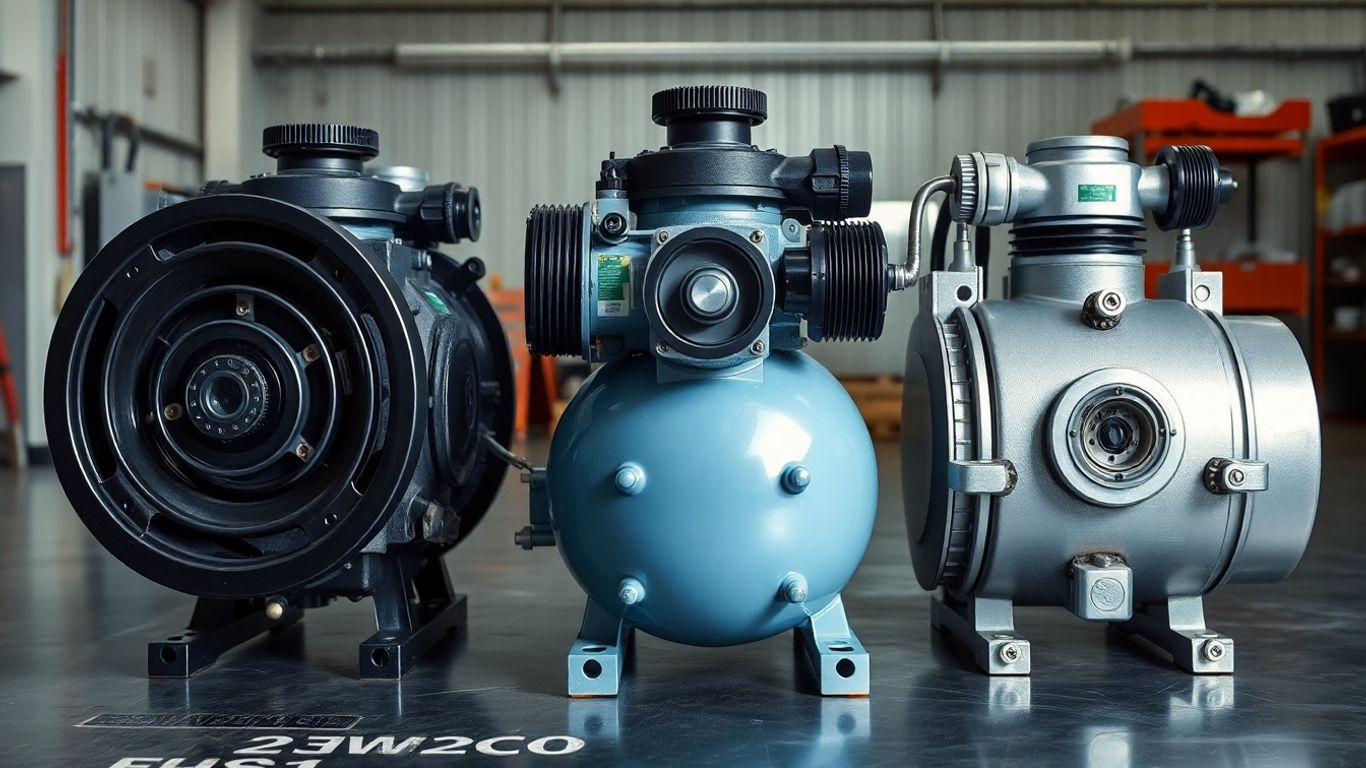
The piston compressor works thanks to a reciprocating motion: a piston moves inside a cylinder to compress the refrigerant. With each cycle, the piston draws in then compresses the gas, which is then discharged towards the condenser. This simple design makes the piston compressor very versatile.
Main structural components:
- Cylinder(s) and piston(s)
- Suction and discharge valves
- Mechanical casing
- Lubrication system (oil)
Precise flow control is possible by managing the number of active cylinders, making it easy to adjust to varying installation requirements.
Piston compressors exist in several configurations:
| Model | Main Characteristics | Typical Applications |
|---|---|---|
| Hermetic | Integrated electric motor welded to the shell, limited maintenance | Small refrigeration units |
| Semi-hermetic | Motor and compressor integrated but removable casing for easier maintenance | Commercial cold rooms |
| Open | Separate motor, belt or coupling drive, full access | Industrial cooling |
Key Points to Consider:
- Hermetic models offer good sealing, essential in no-leak contexts improved sealing performance.
- Semi-hermetic: a compromise between accessibility and compactness
- Open models reserved for high power and environments requiring frequent maintenance
The power range of a piston compressor generally extends from a few hundred watts to several hundred kilowatts. This flexibility explains their use in:
- Supermarkets (refrigerated display cases)
- Storage cold rooms
- Industrial processes at medium and low temperature
- Ice production, mass freezing
The robustness and mechanical simplicity of piston compressors make them a safe choice in many refrigeration environments, even if their energy efficiency is sometimes lower than more recent technologies.
To summarise, the piston compressor remains relevant wherever a proven, repairable, and adaptable technology is needed. Its ability to fit a variety of industrial refrigeration situations continues to appeal to a wide range of users.
The Specifics of the Screw Compressor in Refrigeration
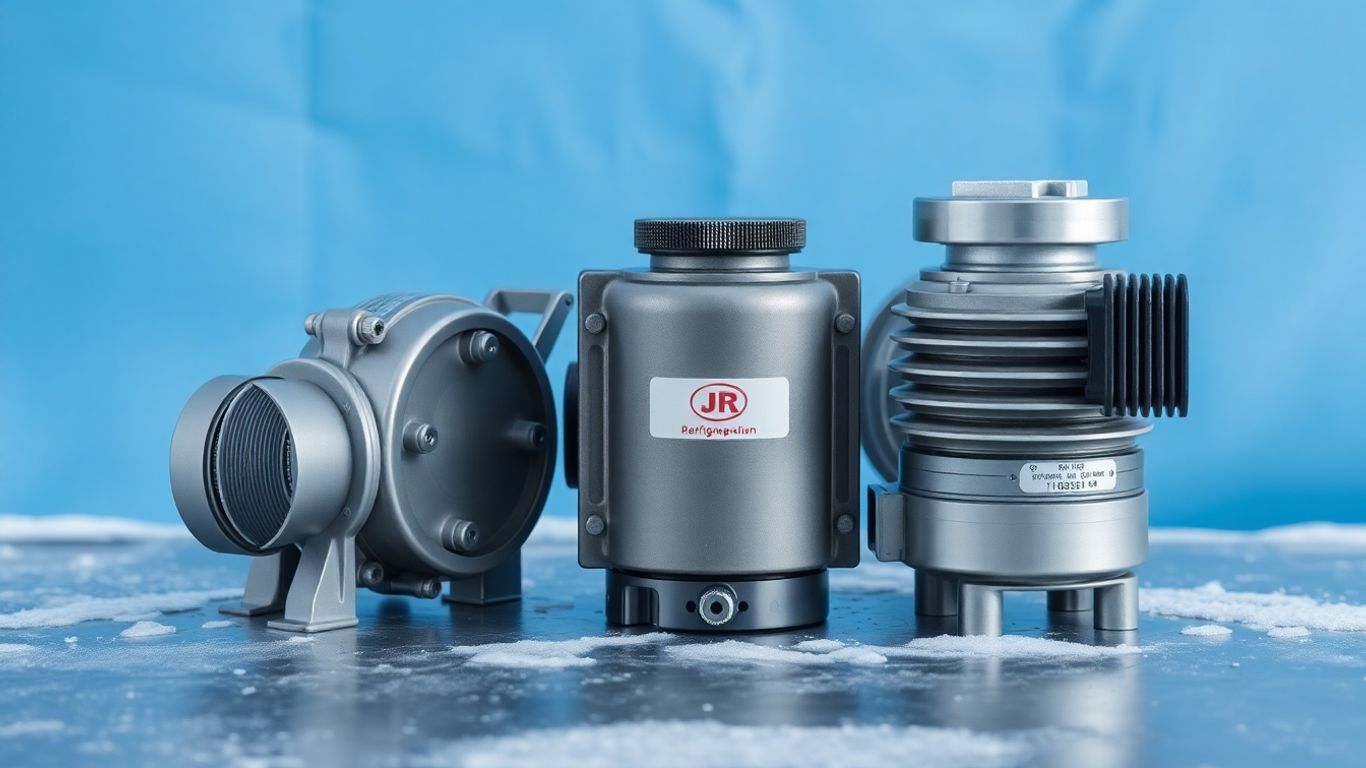
The screw compressor is based on a system of helical rotors. Two screws—one male, one female—mesh and trap the refrigerant, compressing it gradually with each rotation. This principle gives a continuous movement, in contrast to reciprocating types such as piston. The screw compressor thus ensures stable, regular, and reliable compression, especially suited to demanding industrial uses.
Here is a summary of how this technology works:
- The screws create air chambers whose volume decreases, thereby increasing the fluid pressure.
- Continuous operation minimises pulsations.
- Lubrication is essential for sealing and cooling, so regular maintenance is important.
For capacities from 20 to 1200 kW, the screw compressor often outperforms piston types, particularly in large installations requiring stable pressure and long service life.
This type of compressor is known for its high volumetric efficiency. The internal leakage rate stays low, because the rotor contact is precise. Also, power modulation is a real advantage:
- Possibility to adjust capacity without changing rotational speed
- Easy adaptation to actual cooling requirements
- Maintains good efficiency even at part load
A summarised table illustrates performance by compressor type:
| Compressor Type | Power Range (kW) | Volumetric Efficiency | Power Modulation |
|---|---|---|---|
| Piston | 2 – 300 | Medium | Limited |
| Scroll | 3 – 500 | Good | Good |
| Screw | 20 – 1200 | Very good | Excellent |
Source: general estimation, industry trends
If you need to equip industrial cold stores or large distribution facilities, the question of the screw compressor inevitably arises. For a relevant choice, consider:
- Size: screw machines are bulky, but allow the production of very large volumes of cold.
- Cost: the initial investment is higher, but offset long-term by reliability and reduced maintenance.
- Liquid sensitivity: the screw compressor tolerates liquid returns better than a piston, but it remains important to limit this effect.
- Precise modulation: for modular or variable cold systems, this technology stands out as a reference.
In all cases, the screw compressor is often preferred where reliability, continuous performance, and durability are sought. Remember that, according to the general operation of compressors, the pressure achieved depends greatly on internal construction—and the screw, with its rotary movement, reduces the risk of mechanical failure.
Comparing Performance and Selection Criteria for Refrigeration Compressors
Energy Efficiency and Volumetric Efficiency
To choose the type of refrigeration compressor, you must first compare their capacity to turn electrical energy into useful cooling. Volumetric efficiency plays a key role here: it indicates the proportion of volume that is actually compressed compared to the total displaced. A compressor with high volumetric efficiency consumes less for the same cooling output.
| Compressor Type | Recommended COP (kWr/kWe) | Power Ranges (kWc) | Strengths |
|---|---|---|---|
| Scroll | 3.7 – 4.5 | from 3 to 40 (or more in parallel) | Very good efficiency, easy modulation |
| Hermetic piston | 3.0 – 4.0 | from a few kW to several dozen | Good availability, low cost |
| Screw | 4.5 – 5.0 | from 50 to >800 | Best efficiency at full load, high power |
Overall performance also depends on how well the compressor is matched to the rest of the installation.
Reliability and Maintenance Cost
The durability and ease of maintenance vary significantly between the technologies:
- Scroll compressors have few moving parts, which reduces wear and minimises breakdowns.
- Piston models require more maintenance (replacement of rings, valves, etc.) due to repeated mechanical stresses.
- Screw compressors, suited to industrial applications, offer good reliability and fewer shutdowns, but their maintenance requires specialist expertise and their purchase price remains high.
Always calculate the total cost over several years, including purchase price, downtime, and regular or corrective maintenance costs.
Noise Level and Installation Integration
Beyond efficiency, acoustics are a real concern depending on the installation site. Here are some points of comparison:
- Scrolls stand out for their low noise (ideal for occupied spaces or commercial applications).
- Piston compressors, on the other hand, generate significantly more vibration and noise; a dedicated technical room is recommended.
- Screw compressors are intermediate but remain audible at high power; there are special soundproofing kits available.
To reduce noise pollution:
- Use acoustic enclosures.
- Provide a floating slab under the unit.
- Add elastomer mounts under the frame.
In summary, the right choice comes down to a balance of performance, operating cost, integration needs, and expectations for quietness. Take time to evaluate each aspect for your future use.
Selection Criteria by Refrigeration Compressor Application
When selecting a refrigeration compressor, the usage context plays a decisive role. Your choice must match the expected thermal load, the variability of this load, as well as the site configuration and regulatory constraints. Listing your requirements in advance will help you target the most suitable model.
Control Capacity and Load Adaptability
The ability to modulate the compressor’s output according to demand not only impacts overall efficiency, but also the unit’s wear:
- Scroll compressors, for example, often allow for fine control via variable speed, ideal for installations with variable loads or needing flexibility.
- Piston models generally offer stepped control (on/off or cylinder disconnection), providing stage-by-stage management but less smooth handling of rapid changes.
- Screw technology allows continuous output adjustment, particularly suited to industrial settings with significant fluctuations.
| Compressor Type | Possible Control | Recommended Load |
|---|---|---|
| Scroll | Variable speed / parallel units | Low to medium, variable |
| Piston | Stepped, limited variable speed | Medium to very high, staged |
| Screw | Continuous internal ratio variation | High, major fluctuations |
Managing Pressure Variations and Compression Ratio
The match between the compressor’s compression ratio and the real operation of the system is crucial:
- A poorly chosen compression ratio leads to overconsumption and overheating.
- The discharge pressure should be close to the real condensing pressure to avoid running empty.
- Screw compressors with variable internal volume offer automatic adaptation, optimising the energy consumed during transitional phases.
For units facing large load or temperature changes (warehouses, food processing), investing in a smart modulation model limits waste and ensures cold chain stability.
Installation Constraints and Regulatory Considerations
Some practical and regulatory criteria also influence the compressor choice:
- In urban areas, sound levels will often require installation in a technical room with enhanced insulation, or choosing a model known for its quietness
- If regulations demand zero refrigerant leak, prioritise hermetic or semi-hermetic versions with superior tightness
- Consider how the compressor fits into the wider installation (pressure drop, maintenance access, matching with heat exchangers)
Finally, energy considerations lead to favouring optimised equipment, as recommended in various guidance on energy efficiency and cooling capacity appropriate for your situation.
- Minimise pressure losses at the heat exchangers.
- Plan for easy maintenance and overheating protection.
- Check compatibility with new refrigerants and ensure compliance with current regulations.
Current Trends in Refrigeration Compressor Selection
Choices in refrigeration compressors have evolved rapidly in recent years. You now face new expectations: maximum energy performance, easy load adaptation, and compliance with increasingly strict environmental regulations. Let’s explore the major trends shaping your decisions.
Shift Towards Rotary Machines
In practice, the vast majority of recent projects tend towards rotary machines: scroll or screw types. Piston compressors, long a standard, are now declining. Why?
- Fewer moving parts means less wear.
- Noise levels are usually lower, notably for hermetic models.
- No dead spaces improve volumetric efficiency.
- Rotary machines more readily accept load modulation.
For equivalent capacity, plants now prefer several smaller compressors installed in parallel, rather than a single oversized unit:
| Compressor Type | Power Range (kW cooling) | Power Modulation |
|---|---|---|
| Scroll | 3 to 40 per unit (*) | Excellent |
| Screw | 100 to 1200 | Very good (10 to 100%) |
| Piston | 10 to 1000 | Variable |
*(Above 40 kW by using units in parallel)
Focus on Overall Energy Performance
The issue of overall efficiency now takes precedence:
- Close monitoring of the COP (coefficient of performance).
- Reducing electricity use at part load.
- Choosing the most appropriate modulation type (variable speed, slides, central regulation).
An oversized compressor wastes energy. To avoid this, actual required capacity must be measured on site before any replacement or new installation.
To choose well, don’t just go by the maximum output stated. Take time to observe the cycles and actual loads: real-life performance is what counts.
New Environmental Regulations and Zero Leakage
Standards are changing fast and now require equipment designed to minimise refrigerant leaks.
Here’s what you need to consider:
- Opt for hermetic or semi-hermetic models to reduce leak risk.
- Choose technologies proven to handle partial loads.
- Ensure compatibility with low-carbon refrigerants.
Regulatory goals push the whole industry to select reliably long-lasting solutions, while anticipating future sector developments.
In summary, adaptability, energy efficiency, and environmental safety have become unavoidable priorities when choosing your refrigeration compressor.
Conclusion
In summary, the choice between a scroll, piston, or screw compressor really depends on your specific needs. If you want a quiet, reliable, and efficient solution for medium capacities, the scroll is often a good compromise. For simpler setups or smaller capacities, the piston compressor remains a classic option, though maintenance can be more frequent. Finally, for industrial uses or large capacities, the screw compressor is the obvious choice, despite a higher purchase cost. Take the time to assess required capacity, desired control, and installation constraints. This will save you many surprises and ensure optimal operation in the long term.
Frequently Asked Questions (FAQ)
What are the main advantages of the scroll compressor?
The scroll compressor is very efficient because it has no dead space inside. It is also quiet, robust, and reliable as it has few moving parts. It starts quickly and uses little energy. This compressor type is also less sensitive to problems caused by liquid present in the system.
When should I choose a piston compressor?
The piston compressor is often chosen for industrial installations or when large capacities are required. It is available in open, hermetic or semi-hermetic versions. It is suited to systems where there is high variation in pressure.
Why use a screw compressor in industrial refrigeration?
The screw compressor is ideal when large amounts of cooling are needed, for example in big factories or warehouses. It is reliable, long-lasting and can operate over a broad power range. It is also able to adapt easily to demand thanks to its power modulation capability.
How can I choose the right compressor for my installation?
To make a good choice, consider the required power, acceptable noise level, available space and ease of maintenance. You should also think about output control, energy consumption, and rules to prevent gas leaks.
Are all compressors easy to maintain?
No, some compressors such as hermetic models cannot easily be repaired. They are replaced in case of failure. Open or semi-hermetic models are easier to repair, but gasket seals must be closely monitored to avoid leaks.
Are scroll compressors suitable for all applications?
Scroll compressors are mainly used in air conditioning, heat pumps, and small refrigeration systems. For very high capacities or industrial needs, the screw or piston compressor is usually more suitable.
