
Are you considering installing a Canadian well at your home? It’s an excellent idea to improve your home’s comfort while saving energy. This system uses the stable temperature of the soil to preheat air in winter and cool it in summer. But for it to work at its best, there are important questions to ask, particularly about the depth to which you need to dig. Let’s talk a bit about this subject: Canadian well depth, how deep to dig, and why it’s so important.
Key Takeaways
- The Canadian well uses the constant temperature of the soil, located at a certain depth, to adjust the temperature of the air entering your home. In winter, it heats the air, and in summer, it cools it.
- The ideal depth for a Canadian well is a key factor in its efficiency. The deeper you go, the more stable the soil temperature, which improves the system’s performance.
- There isn’t a single depth for all Canadian wells. It depends on the region, soil type, and your home’s needs. A standard depth is often 2 metres, but a personalised study is preferable.
- The sizing of a Canadian well takes into account your energy needs, the choice of conduit materials, their layout, and condensate management to prevent humidity.
- Installing a Canadian well requires specific skills. It is recommended to call on a qualified professional to ensure the system’s safety, efficiency, and longevity, particularly to respect conduit slopes and manage risks like radon.
Understanding the Fundamental Principles of the Canadian Well
The Canadian well, also known as a Provençal well for its cooling function, is an ingenious system that uses the stable temperature of the soil to preheat air in winter and cool it in summer before it enters your home. It is a geothermal device based on a simple but very effective principle.
The Role of Soil Temperature
Outdoor air temperature varies considerably throughout the seasons, from negative temperatures in winter to heat peaks in summer. However, at a certain depth below the surface, the soil temperature remains remarkably constant, generally around 10 to 15°C depending on the region. It is this thermal stability of the soil that the Canadian well exploits. By circulating the air from your home through buried conduits, the air takes on the temperature of the soil. In winter, cold incoming air is heated by the soil, and in summer, hot air is cooled by the coolness of the soil. This natural regulation significantly reduces heating and air conditioning needs.
The Thermal Inertia of the Soil
The efficiency of the Canadian well relies on the soil’s ability to store and release heat, known as thermal inertia. The soil acts as a vast energy reservoir. In winter, it releases heat accumulated during the warmer months, while in summer, it absorbs ambient heat, acting as a cooling sink. The greater the mass of earth through which the air passes, the more effective the heat exchange will be. This is why the depth at which the conduits are installed is a determining factor for the system’s performance.
Seasonal Operation of the Device
The operation of the Canadian well is directly linked to the seasons and the temperature difference between the outdoor air and the soil:
- In winter: Outdoor air, often very cold, is drawn in and passes through the buried conduits. As it travels through the soil, it heats up to a more moderate temperature, close to that of the soil. This preheated air is then distributed into the home, reducing the load on your main heating system.
- In summer: Conversely, when the outdoor air is scorching, it is also directed into the buried conduits. The soil, cooler than the ambient air, absorbs the air’s heat, thus cooling it before it enters the house. It is in this case that we specifically refer to it as a Provençal well.
This system therefore provides a double beneficial action: a supply of preheated or pre-cooled fresh air, contributing to thermal comfort and indoor air quality, while achieving substantial energy savings.
Determining the Ideal Depth for a Canadian Well
The Importance of Depth for Performance
The depth at which you install your conduit network is a determining factor for the efficiency of your Canadian well. The soil, at a certain depth, maintains a relatively stable temperature throughout the year, far from the extreme variations experienced at the surface. It is this thermal inertia of the soil that the system exploits. The deeper you go, the closer the soil temperature gets to a constant annual average. A well-chosen depth therefore maximises air preheating in winter and precooling in summer. Ignoring this aspect risks seeing the performance of your installation decrease considerably, or even become negligible.
Standard Depth and Optimisation
The commonly accepted depth for a Canadian well is around 2 metres. This is a starting point, often sufficient to achieve a noticeable benefit. However, for optimal performance, it is advisable not to stop at this standard. The idea is to reach the most stable soil temperature possible. In many cases, digging a little deeper, for example between 2.5 and 3 metres, can significantly improve heat exchange. The right balance must be found between the cost of excavation work and the expected energy gain. Consider consulting the specifics of your land and soil type to refine this decision.
Factors Influencing Optimal Depth
Several elements come into play in defining the ideal depth for your installation. The nature of the soil is paramount: clay soil will not have the same thermal conductivity as sandy soil. The geographical area also plays a role; in regions with harsher winters, it may be wise to dig deeper. The total length of your buried conduits is also a factor: the longer the air path, the more time it has to exchange heat with the soil. Finally, the budget allocated for the work must be considered. An in-depth analysis of these points will help you determine the most relevant depth for your project.
- Soil type: Thermal conductivity and moisture content.
- Local climate: Average and extreme temperatures.
- Conduit length: Heat exchange time.
- Budget: Excavation and installation costs.
It is often more effective to favour a greater conduit length over excessive depth, as the air needs time to adapt to the soil temperature. Air speed that is too high in the conduits reduces the efficiency of heat exchange.
Sizing and Design of a Canadian Well
Assessing the Building’s Energy Needs
Before embarking on the installation of a Canadian well, it is essential to thoroughly understand your home’s needs. It’s not just about digging a hole and running a pipe, you know. You really need to understand how your house behaves thermally. Does it lose a lot of heat in winter? Does it overheat in summer? Answering these questions will help you determine if a Canadian well is a good idea for you and, above all, which system will be most suitable. A thermal simulation can be very useful for this. It allows you to precisely see heat losses, how to heat and ventilate, and what savings you could achieve on your heating system. The more you anticipate this step, the better.
Choice of Materials and Conduit Characteristics
The choice of conduits is an important step, as it is through them that the air you will breathe will pass. Therefore, you must opt for quality materials, often described as “food-grade”. Common options include vitrified stoneware, polypropylene, or corrugated polyethylene ducts specifically designed for Canadian wells. Polypropylene has the advantage of being radon-tight, which may be a point to consider depending on your region. Mechanical resistance is also a factor; some conduits are more robust than others and better withstand soil aggressions or tree roots. The lifespan of these conduits is expected to be that of your house.
Management of the Route and Pressure Losses
The way the conduits are installed, their route, has a direct impact on the efficiency of your system. Tight bends should be avoided as much as possible, as they increase what are known as “pressure losses,” i.e., resistance to air flow. A well-thought-out route, following the terrain’s topography if possible, can reduce the amount of earth to be moved and simplify installation. The total length of the buried conduits is a key element: the longer it is, the more time the air has to approach the soil temperature. A minimum length is often mentioned for a significant impact, for example, 50 metres in total for a 200 mm diameter collector. It is also advisable to provide a slight slope in the conduits to facilitate condensate drainage, the water that naturally forms in the system.
Here are a few points to keep in mind for the conduit route:
- Avoid bends: They slow down the air and reduce efficiency.
- Minimum slope: A 2% slope is recommended for water drainage.
- Distance from trees: Bury conduits more than 2 metres away from trees to avoid roots.
- Depth: A depth of 1.5 to 2.5 metres is generally sufficient to capture a stable temperature.
The precise sizing of the conduit network, taking into account the required airflow and the speed of this airflow (ideally no more than 2 m/s), is what guarantees good heat exchange with the soil. Air that flows too quickly does not have time to heat up or cool down properly.
Technical Aspects of Canadian Well Installation
The installation of a Canadian well requires particular attention to technical details to ensure its proper functioning and the quality of the air you breathe. It is not a simple matter of laying pipes; every step counts to optimise the system’s performance and durability.
Outdoor Air Intake and its Location
The starting point of your system is the outdoor air intake. It is important to position it judiciously. It must be located at a minimum height of 1.40 metres from the ground to avoid drawing in air polluted by road traffic, composting areas, or even pollen from surrounding plants. Furthermore, this air intake must be equipped with a filter (G3/G4 type) and a fine grille. These elements are there to prevent the entry of insects, dead leaves, and large particles, while allowing the necessary air to pass through for the system.
The Conduit Network and its Slope
The conduit network, generally buried, plays a central role. The burial depth is usually between 1.5 and 2.5 metres. This depth is sufficient to benefit from the relatively stable soil temperature and thus good performance. The total length of the conduits is a key factor; a minimum length is often mentioned for a significant impact, sometimes around 50 metres, or several shorter parallel sections. It is imperative that these conduits have a minimum slope of 2%. This inclination is essential to allow natural drainage of the condensate that will form in the system. Avoid running conduits under the house, as this could capture indoor heat and reduce the system’s efficiency. Also, ensure they are kept away from tree roots (more than 2 metres) and hedges or shrubs (more than 1 metre).
Condensate Management and Water Drainage
Condensation is inevitable in a Canadian well, especially when the outdoor air is more humid than the soil. The 2% slope mentioned earlier is the first step in managing this condensate. It is also necessary to provide drainage points or inspection chambers. These devices allow the collected water to be collected and removed, preventing stagnation, mould growth, and conduit degradation. Proper condensate management is crucial for air hygiene and the longevity of the installation.
The installation of a Canadian well requires meticulous planning. The choice of conduit materials, their route, the management of slopes and condensate, as well as the location of the air intake are all technical parameters that, if well mastered, guarantee the efficiency and hygiene of your natural ventilation system.
Considerations Regarding the Canadian Well
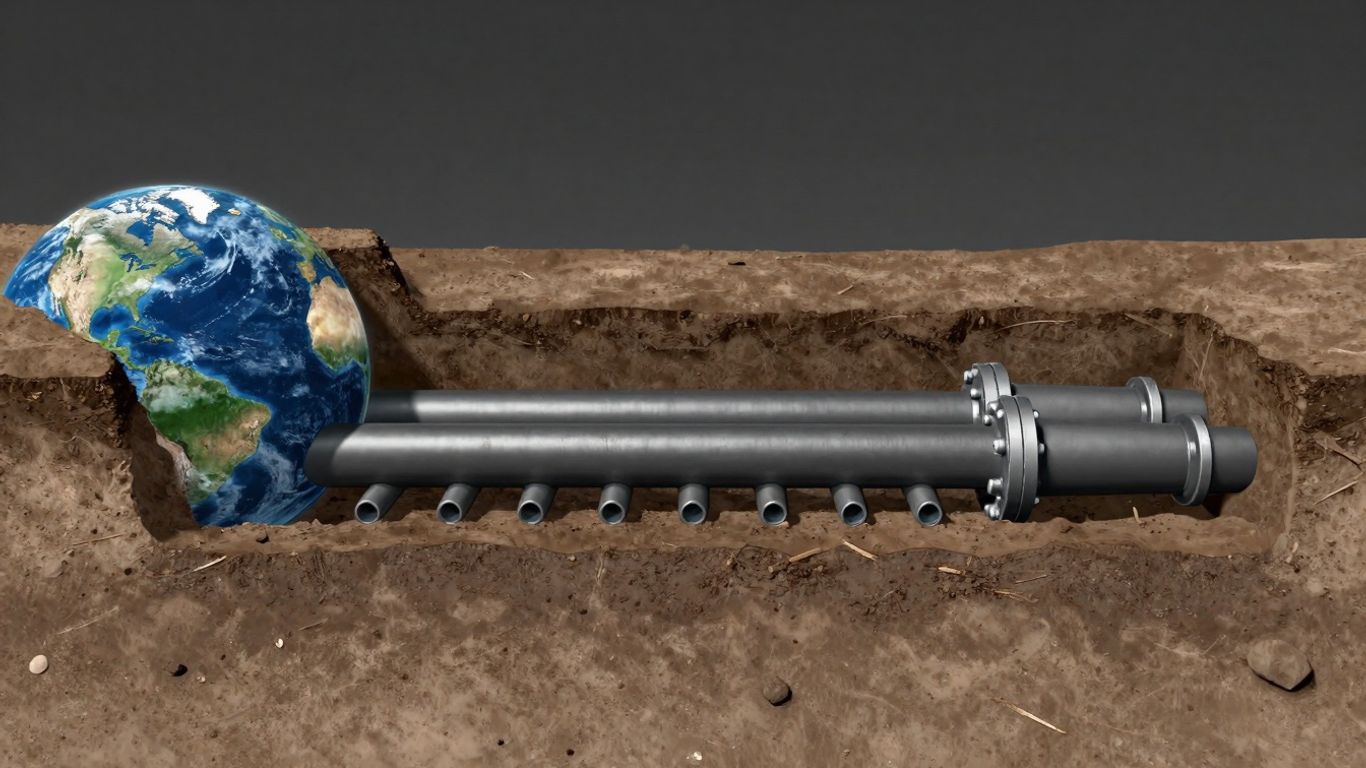
Before embarking on the installation of a Canadian well, it is important to weigh certain technical and sanitary aspects. This system, although efficient, requires particular attention to ensure its proper functioning and the quality of the air you breathe.
Choice Between Air Well and Water Well
The most common Canadian well is the air well, which directly uses ambient air. However, there are also water well systems that utilise the temperature of a water table. The choice will depend on your geographical location and the availability of water resources. Air wells are generally simpler to implement, but water wells can offer better thermal regulation in certain conditions. It is also possible to find hybrid systems that combine both approaches to optimise performance.
Health Precautions and Air Quality
The air you inhale passes through the buried conduits. It is therefore essential to ensure the quality of this air. Condensation is a natural phenomenon in the conduits, especially in summer. If it is not properly drained, it can promote the development of bacteria and mould. To avoid this, a 2% slope is essential to allow condensate to flow to a low point where it can be collected and drained. The choice of food-grade materials for the conduits is also an important health measure. A well-positioned outdoor air intake, far from pollution sources, and equipped with a high-performance filter (G4 type) is also a key element for ensuring healthy air. It is recommended to consult the guidelines on the design of drinking water production facilities to understand the principles of filtration and air treatment, even if the context is different caisson wells.
Impact of Radon on the System
Radon is a natural radioactive gas that can be present in the soil. If it enters your home via the ventilation system, it can pose a health risk. Some conduit materials are more radon-tight than others. Polypropylene pipes, for example, offer good resistance to this gas. If your region is known for its high radon levels, it is advisable to choose suitable materials and ensure adequate ventilation to dilute any potential concentration. A preliminary soil study can inform you about the presence of radon in your area.
- Check for the presence of radon in the soil.
- Choose radon-tight conduit materials.
- Implement adequate ventilation to dilute the gas.
- Regular maintenance of the system to prevent pollutant build-up.
Condensate management is a technical point often underestimated. Poor drainage can turn a beneficial system into a source of health problems. Therefore, particular attention must be paid to conduit slopes and the design of low points.
Costs and Professionalism in Installation
The installation of a Canadian well represents an investment, and it is important to fully understand the various cost items as well as the importance of using competent professionals.
Estimating the Installation Budget
The cost of a Canadian well can vary considerably, generally ranging from €1,500 to €5,000 excluding VAT, not including engineering, excavation, installation, and setup costs. Excavation, in particular, can represent a significant portion of the budget, sometimes between €500 and €1,000. It is often more economical to plan the installation during the new construction of your home, as the work is then simpler to integrate.
Here is an idea of potential costs:
- Materials only: Budget between €750 and €3,000 for a double-flow VMC, which is often coupled with the Canadian well. Specific Canadian well materials (conduits, etc.) can add €1,500 to €5,000 excluding VAT.
- Excavation: Varies depending on the configuration, but budget at least €500 to €1,000.
- Professional installation: This cost is in addition to the materials and can double the total budget, depending on the complexity of the site.
It should be noted that the Canadian well is not eligible for tax credits, meaning you will not benefit from a tax advantage on its cost.
The Importance of Choosing a Qualified Professional
The installation of a Canadian well is no small feat. It requires precise technical skills to ensure its proper functioning and durability. Poor installation can lead to humidity problems, premature degradation of conduits, or even health risks related to air quality, such as the presence of radon.
Therefore, calling on a qualified professional is essential. They will ensure that the necessary slopes for condensate drainage are respected, that the conduits are airtight, and that the system is correctly sized for your energy needs. An experienced installer will also be able to advise you on the choice of the most suitable materials for your situation, whether it be PE conduits (more robust and easier to install) or other solutions.
Comparison of Costs According to Site Complexity
The complexity of your site will have a direct impact on the final quote. Several factors are involved:
- Type of construction: A new house will generally be less expensive to equip than a renovation, where demolition work or more significant adaptations may be necessary.
- Site accessibility: Easy access for construction machinery will simplify excavation and reduce costs.
- Site configuration: The presence of natural obstacles or the need to dig to significant depths will influence the time and cost of excavation work.
- Choice of materials: As mentioned, some types of conduits are more expensive but can reduce installation time, which can offset the initial extra cost.
It is therefore advisable to request several detailed quotes from recognised professionals to compare offers and ensure you make the most judicious choice for your project.
To Conclude on Your Canadian Well Project
So, we’ve covered what you need to know about the depth of a Canadian well. As you’ve seen, there isn’t a single answer; it really depends on your land and what you expect from the system. We often talk about 2 metres as a baseline, but the deeper it is, the better, within certain limits of course. The most important thing is to think carefully about all of this before digging. Consider the soil type, the length of the pipes, and, above all, ensure proper condensate drainage to avoid problems. If you do it by the book, you’ll have a system that will provide comfort and energy savings for years to come. Don’t hesitate to seek advice from professionals if you have any doubts, because a well-done installation makes all the difference.
Frequently Asked Questions
What is the ideal depth for a Canadian well?
For your Canadian well to function optimally, it’s important to dig it deep enough. It’s often said that the standard depth is around 2 metres. However, the deeper you go, the more stable the air temperature will be, which will improve performance. Therefore, you need to find the right balance based on your land and what you want to achieve.
How do I know if a Canadian well is suitable for my home?
Before you start, you need to think carefully about your home’s needs. Does it need heating or cooling? What is the size of the house? You also need to look at the surrounding land. A thermal simulation can help you understand how the Canadian well will help save energy and improve comfort.
What materials should be used for Canadian well pipes?
The pipes are very important because it’s through them that the air will pass before reaching your home. You need to choose quality materials, like those used for water supply. Vitrified stoneware or certain types of polyethylene are good choices. You need to ensure they won’t let anything harmful into the air you breathe.
Do I need to worry about water that might form in the pipes?
Yes, it’s possible for condensation to form, especially in summer. That’s why it’s essential for the pipes to be slightly inclined. This slope allows water to drain to a low point where it can be evacuated. If water stagnates, it can cause humidity problems and bad odours.
Can a Canadian well be dangerous to health?
If the installation is not done correctly, there are risks. For example, if the pipes are not chosen properly or if water stagnates, bacteria or mould can develop. There is also the risk associated with radon, a natural gas. That’s why it’s crucial to use a professional who will adhere to all the rules to ensure healthy air.
How much does it cost to install a Canadian well?
The price can vary quite a bit. You should budget at least 2,000 euros for good quality materials alone. Added to this are the excavation costs, which can be quite significant, and labour if you don’t do the work yourself. It’s an investment, but it can lead to savings on heating and air conditioning later on.
