
In the vast world of industrial heating, the air heater holds a prominent position. If you manage a warehouse or a large space, you’ve surely asked yourself how to efficiently heat these volumes. The air heater, with its ability to quickly diffuse warm air, might seem like an obvious solution. But how does it actually work? What factors should be considered before making your choice? And how can you ensure the installation is optimal for maximum comfort and controlled consumption? This article will explore these points to help you better understand and choose the right air heater for your needs.
Key Takeaways
- Understanding how air heaters, whether hot water or gas-powered, function is the first step towards an informed choice.
- The choice of an air heater depends on several factors: your building’s insulation, your precise thermal needs, and the dimensions of the space to be heated.
- Good heat distribution is essential; you need to consider counteracting air stratification, particularly with destratifiers or air curtains.
- Installing an air heater requires careful attention to strategic positioning and connection to heat sources.
- The energy efficiency of your air heater system can be optimised through good regulation and by considering the electrical consumption of the fans.
Understanding How Air Heaters Work
Air heaters are heating appliances designed to diffuse warm air into large volumes, such as warehouses. Their operating principle is based on convection, which is the transfer of heat through air movement. You might wonder how these machines manage to effectively heat vast spaces. Let’s look closer.
Basic Principles of Hot Water Air Heaters
Hot water air heaters operate using a hot water circuit, typically produced by a boiler. The hot water circulates through a heat exchanger integrated into the air heater. A fan draws in ambient air, passes it through this exchanger where it heats up, and then diffuses it into the warehouse. The power of these units typically ranges from 10 to 100 kW, depending on the water temperature flowing through them. The overall efficiency of this system, including the boiler and distribution, can reach around 80% under optimal conditions.
- Advantages: They are often more affordable to purchase and simpler to install than other systems. They are well-suited for well-insulated spaces and do not pose issues with combustion gas evacuation.
- Disadvantages: The forced warm air tends to rise and stratify at the ceiling, especially if the units are poorly positioned. Insulation of the water circuits is crucial to prevent heat loss before the air is even heated.
How Gas Air Heaters Work
Gas air heaters use the direct combustion of gas to heat air. They are often more powerful than their water-based counterparts, with capacities ranging from 20 to 200 kW. Recent models, known as “sealed” units, improve efficiency by preventing ambient air loss when the appliance is off. “Condensing” versions further enhance efficiency, sometimes exceeding 100% by recovering latent heat from the flue gases.
It is important to note that the warm air blown by these appliances is at a high temperature and can quickly stratify. Furthermore, they propel air over a limited distance, generally between 5 and 15 metres, and require flue gas evacuation to the outside.
- Advantages: They offer greater power for a reduced footprint and higher combustion efficiencies. Power can be adjusted via a thermostat.
- Disadvantages: Stratification of warm air is a major issue, as is the dispersion of ambient dust by the fans. Zone heating is also more complex to implement.
Modern Air Heater Technologies
Manufacturers are constantly seeking to improve the efficiency and comfort provided by air heaters. A notable innovation concerns induction blowing systems. These systems use special fins to mix the blown warm air with ambient air, propelling it at higher speeds and over longer distances (over 15 metres). This allows for better heat distribution, reduces stratification, and reaches the desired temperature in the space more quickly.
- Airflow Optimisation: Induction systems improve the reach of warm air streams.
- Stratification Reduction: By mixing the air, heat concentration at the ceiling is limited.
- Increased Comfort: The temperature is more uniform throughout the heated volume.
Turning off fans and water circulators when heating is not needed is a simple but effective measure to prevent unnecessary electricity consumption and heat loss. The use of electronic speed variators (ESVs) to control the power of fans and circulators allows for fine-tuning heating based on demand, thereby increasing the overall system efficiency.
Essential Criteria for Choosing an Air Heater
Choosing the right air heater for your warehouse is a bit like choosing the right pair of shoes for a long hike. It needs to be comfortable, effective, and suited to the terrain. Several factors come into play, and it’s important not to overlook them to avoid unpleasant surprises and ensure optimal thermal comfort.
Analysis of the Building Envelope
Before even looking at air heater models, you need to thoroughly understand your building. What is its insulation like? Are the walls thick? Is the roof well-sealed? These questions are important because they determine how much heat escapes. A poorly insulated building will require more heating power, and therefore a more robust air heater, or you’ll need to consider improving the insulation first. You can estimate the overall heat loss coefficient (K) of your building. This coefficient, combined with the temperature difference between the inside and outside (the famous delta T), will give you an idea of the total power required.
Determining Thermal Needs
Once you have an idea of your building’s performance, you need to precisely calculate your heating needs. This depends on several things: the average winter outdoor temperature in your region, the temperature you want to maintain indoors for optimal comfort, and of course, the total volume of your warehouse. A simple formula can be used: total power required (P tot) equals the heat loss coefficient (K) multiplied by the temperature difference (delta T). For a large industrial space, it’s often estimated that 20 to 65 Watts per cubic metre is needed.
Considerations for Space Height and Volume
The size of your warehouse matters, of course, but so does its height. In large volumes, warm air tends to rise and accumulate near the ceiling, a phenomenon called stratification. If your ceiling is very high, this warm air can escape through the roof without ever coming down to heat the area where people or goods are. Therefore, you need to consider how the warm air will be distributed. Sometimes, placing air heaters lower or using destratification systems can make a big difference. The total airflow required for good air circulation can be calculated based on your space’s volume. For example, for a volume of 5000 m³, an airflow of 3.3 times the volume per hour is often recommended.
It is important to remember that the goal is not just to heat the air, but to maintain a comfortable and constant temperature in the work or storage area. Poor heat distribution can lead to cold spots and overly hot areas, which is inefficient and uncomfortable.
Optimising Heat Distribution
Once your air heater is chosen and installed, it is crucial to consider how heat spreads throughout your warehouse. Poor distribution can lead to cold spots, energy waste, and general discomfort. Therefore, strategies must be put in place to ensure warm air effectively reaches all areas of your space.
Strategies to Counteract Air Stratification
Stratification of warm air, the phenomenon where warm air accumulates near the ceiling, is an enemy of efficiency. Warm air, being lighter, rises and gets trapped at height, far from the work areas. This leads to significant heat loss through the roof, especially if the insulation is not perfect. To combat this, you need to ensure that warm air is actively brought back down to the floor.
- Unit Positioning: Position your air heaters so that their airflow can circulate freely and reach the desired areas without being blocked by obstacles (machinery, offices, etc.).
- Circuit Insulation: Do not forget to properly insulate the hot water pipes. If the pipes are not insulated, the air heated by them can remain stratified at the ceiling and be lost before reaching the area to be heated.
- Use of Induction Systems: Some modern air heaters are equipped with induction systems. These devices use special fins to mix the blown warm air with ambient air and project it further and faster (up to 10 m/s), thereby improving reach and reducing stratification.
Role of Destratifiers and Air Curtains
For even finer heat management, complementary equipment can be very useful.
Destratifiers are fans designed to push warm air accumulated at the ceiling down to the living areas. Well-distributed throughout the space, they significantly improve comfort and temperature uniformity at floor level.
Air curtains, on the other hand, are often installed above large doors. They create a barrier of warm air that limits the entry of cold outside air when the doors are opened. They also contribute to destratification and heat distribution in large halls.
Improving the Reach of Warm Air Streams
The reach of warm air streams is a key factor in efficiently heating a large space. Standard air heaters can have limited reach, effectively heating only a few metres. To overcome this, several approaches exist:
- Choosing High-Performance Air Heaters: Opt for models designed for long reach, sometimes called
Installation and Implementation of Air Heaters
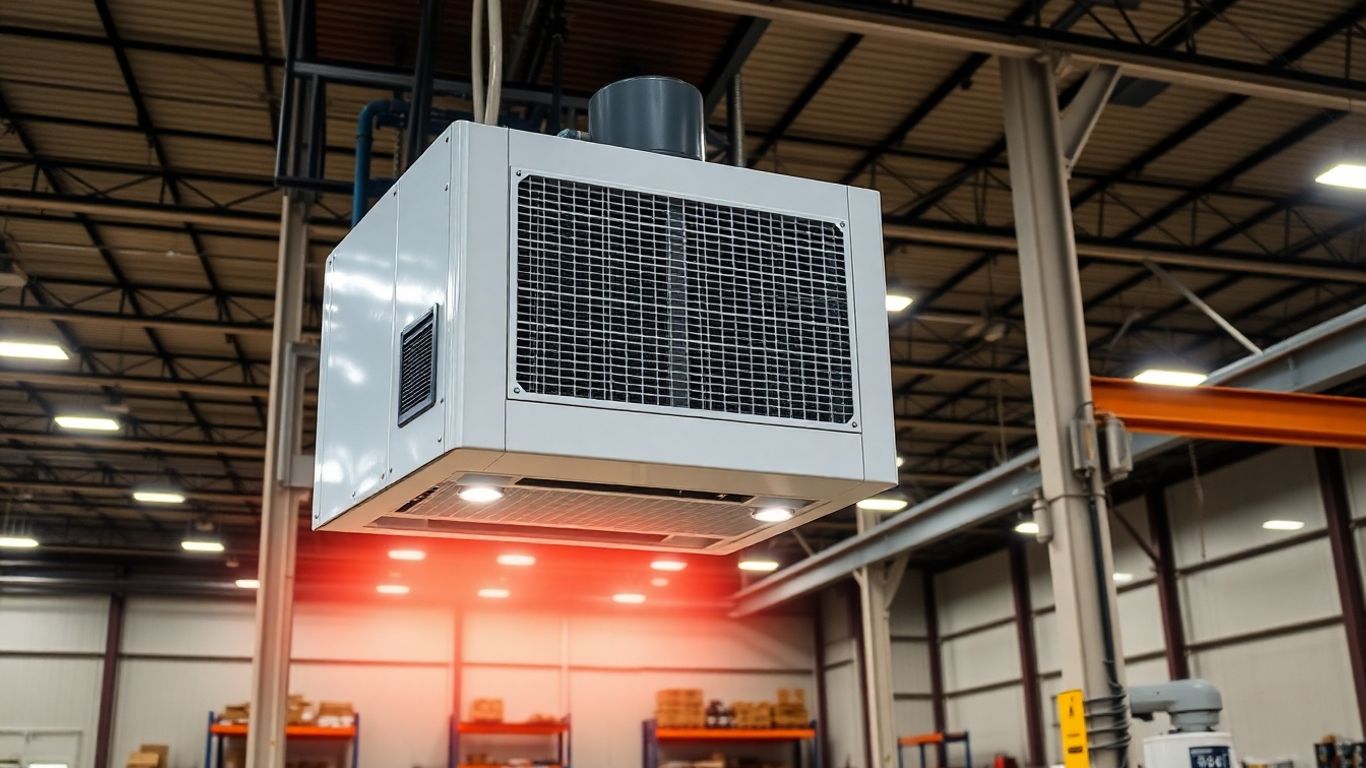
The correct installation of your air heaters is a key step to ensure their efficiency and the performance of your warehouse heating system. Thoughtful installation optimises heat distribution and minimises energy loss. It’s not just about hanging them on the wall; several aspects deserve your attention.
Strategic Positioning of Units
The placement of air heaters must be considered to ensure uniform thermal coverage of the space. It is generally recommended to install them at a height, under the ceiling, to take advantage of the natural phenomenon of warm air stratification. Warm air, being lighter, rises and accumulates near the ceiling. By positioning the air heaters upstream of this mass of warm air, you facilitate its redistribution to the work areas. Avoid placing units in a way that obstacles, such as high shelving or partitions, block the airflow. Such positioning could create cold spots and reduce the overall system efficiency. Consider the direction of airflow and how it will interact with your warehouse layout.
Importance of Circuit Insulation
The circuits that carry hot water to the air heaters (in the case of hydraulic models) are often a significant source of heat loss. If these pipes are not properly insulated, the water can lose some of its heat before even reaching the air heater’s exchanger. This lost warm air, ending up at height, contributes to stratification and escapes through the roof, without ever effectively heating the workspace. Careful insulation of the pipework, especially those located at the upper levels, is therefore essential to maintain water temperature and maximise your installation’s efficiency. This may seem like a minor detail, but the impact on your energy bill can be significant.
Connection to Heat Production Systems
Connecting the air heaters to your main heat source (gas boiler, heat pump, etc.) must be done according to best practices. This includes adhering to appropriate pipe diameters to ensure good water flow, as well as installing shut-off and drain valves. For gas air heaters, connection to the gas supply and flue gas evacuation must be carried out by a qualified professional, in compliance with current safety standards. Particular attention must be paid to flue gas evacuation systems for non-sealed models, to avoid any risk to indoor air quality. The installation of thermostats and control systems is also essential to adjust heating power according to actual needs and optimise energy consumption.
Energy Efficiency and Performance of Air Heaters
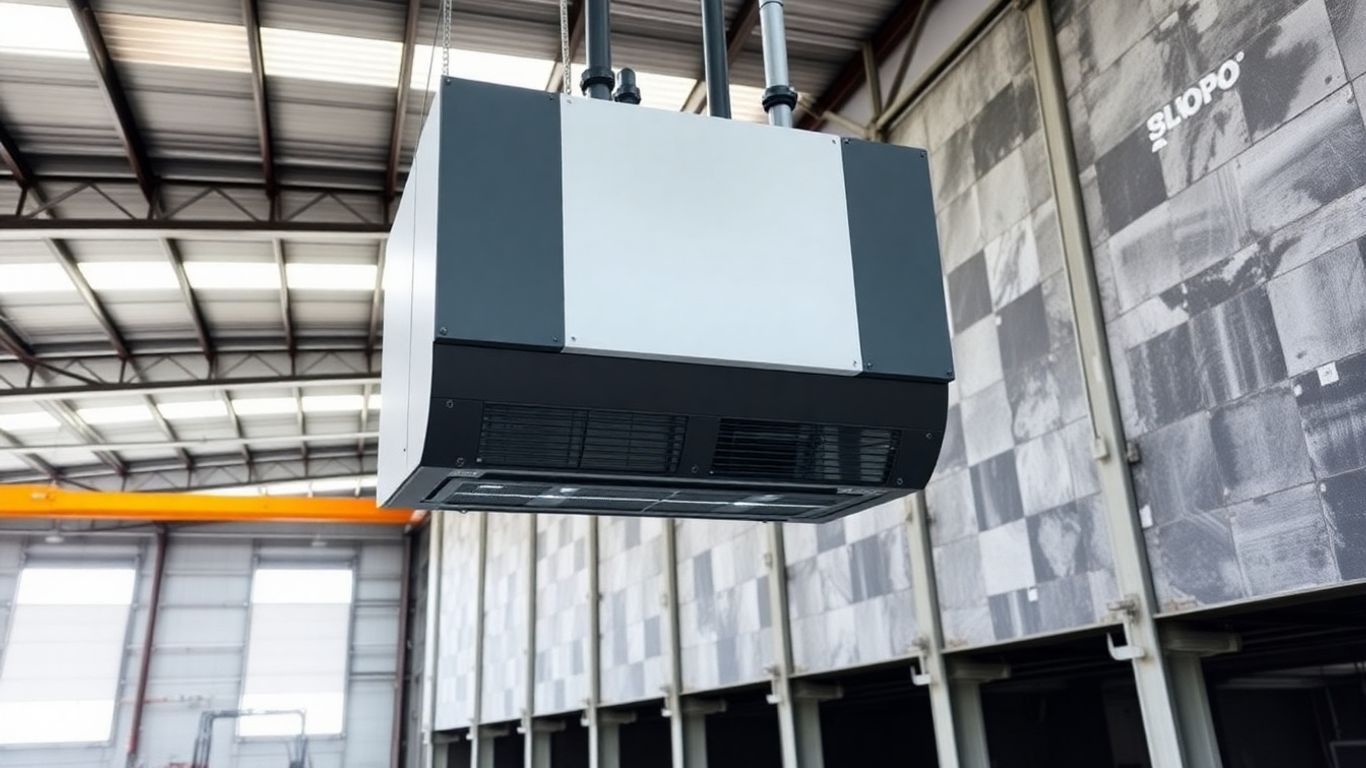
The energy efficiency of your air heaters is a key point for controlling your heating costs. It’s not just about the raw power of the unit, but how it uses that energy to heat your warehouse optimally. Understanding the overall efficiency and the impact of each component will help you make the best choices.
The overall efficiency of your air heater heating system does not depend solely on the appliance itself. It is a combination of several factors. For hot water air heaters, for example, you need to consider the efficiency of the air heater’s heat exchanger, the seasonal efficiency of the boiler that produces the hot water, the efficiency of distributing that hot water to the air heaters, and finally, the efficiency of the regulation that adjusts the temperature. At best, this overall efficiency can reach around 80%.
For gas air heaters, combustion efficiency can reach up to 90%. Recent models, known as “sealed” units, prevent natural draft losses when the appliance is off, which improves energy savings. “Condensing sealed” versions go even further, with combustion efficiencies exceeding 100% by recovering the latent heat from the water vapour in the flue gases.
Impact of Regulation and Power
The nominal power of an air heater varies considerably. For water models, it can range from 10 to 100 kW, while gas models cover a wider range, from 20 to 200 kW. However, high power is not always synonymous with efficiency. Precise regulation is paramount. The use of electronic speed variators (ESVs) for fans and circulators, coupled with thermostatic probes, allows for adjusting heating power to actual demand. This prevents unnecessary overheating and reduces energy consumption. A well-regulated system can significantly increase overall efficiency.
Optimising Fan Electrical Consumption
The fans in air heaters consume electricity, typically a few hundred watts per unit. To optimise this consumption, it is wise to turn them off when there is no heating demand. Similarly, if the air heater is not in use, it is preferable to turn off the hot water circulator or close the circuit valve. This prevents heat loss through the distribution circuit and the inactive appliance’s heat exchanger. Insulation of hot water pipes is also a point not to be overlooked; uninsulated pipes at height allow warm air to escape towards the roof before it even reaches the area to be heated.
Energy efficiency is not limited to purchasing a high-performance appliance. It lies in intelligent management of its operation, precise adaptation to needs, and rigorous maintenance of the various components of the heating system.
Advantages and Disadvantages of Air Heaters
Air heaters offer a set of advantages that explain their popularity in warehouse heating, but it is also important to be aware of their limitations to make an informed choice.
Economic Benefits and Ease of Installation
One of the main attractions of air heaters is their often more affordable purchase cost compared to other industrial heating systems. Their implementation is generally simpler and faster, which reduces installation costs. Furthermore, their maintenance is relatively straightforward, contributing to controlled long-term operating costs. They adapt well to large volumes and can be easily expanded if your needs evolve. This is a system that can be ATEX certified, provided the fan motor complies.
Limitations Related to Dust Dispersion
A point of caution concerns the management of airborne particles. Air heaters, by their operating principle involving ventilation, tend to propel ambient dust and other fine particles. In environments where air cleanliness is a major concern, such as in certain workshops or sensitive storage areas, this can be problematic. It is therefore advisable to carefully assess the nature of your activity before making a decision.
Comparison with Other Heating Systems
Compared to other solutions like hot water radiators, air heaters stand out for their ability to quickly diffuse warm air into large volumes. However, radiators have the advantage of not moving air, thus avoiding dust dispersion. Gas air heaters, on the other hand, offer higher power and often superior combustion efficiencies, but require exhaust gas evacuation. The overall efficiency of your heating system will strongly depend on your building’s insulation and how you manage warm air stratification. For more consistent and potentially more economical long-term heating, you might also consider options like pellet stoves, although their initial cost is higher and they require regular maintenance. Optimising fan electrical consumption and using high-performance controls are ways to improve the efficiency of your existing installation.
In Summary, to Heat Your Warehouse Effectively
Choosing the right heating system for your warehouse is a bit like choosing the right pair of shoes: it needs to be suitable for the purpose and comfortable. You’ve seen that there are several options, such as air heaters, which can be a good solution if your space is well-insulated and you need to heat it quickly. But be careful, they need to be placed correctly so that the warm air circulates everywhere and doesn’t get stuck at the ceiling. Also, think about your building’s insulation; it’s really the foundation for not losing heat unnecessarily. And don’t forget, good adjustment and sensible use can make a real difference to your energy bill. Take the time to thoroughly assess your situation, consider the criteria we’ve discussed, and if necessary, seek professional advice. A well-heated warehouse means more comfort for you and your teams, and better overall efficiency.
Frequently Asked Questions
How does an air heater work to heat a large space like a warehouse?
An air heater works by drawing in ambient air, heating it using an exchanger (powered by hot water or gas), and then blowing it back into the warehouse using a fan. It’s a bit like a large industrial hairdryer that diffuses warm air.
What are the important criteria for choosing the right air heater for my building?
To choose well, you need to consider the size of your building (volume and height), its insulation (walls, roof), the usual outdoor temperature, and the temperature you want indoors. You also need to think about the use of the space: is it occupied all the time or only at certain times?
Why does warm air rise to the ceiling and how can this be remedied?
Warm air is lighter than cold air, so it naturally rises. This phenomenon is called stratification. To counteract it, devices called destratifiers are used, which circulate the air to bring heat back down to the floor where people are. Air curtains near doors also help keep heat inside.
Where should air heaters be placed to heat everywhere effectively?
It is crucial to place your air heaters correctly. The ideal is to install them at a height, so that the warm air they blow can spread throughout the volume without being blocked by obstacles. You also need to ensure that the pipes carrying hot water are well insulated to avoid heat loss along the way.
Are air heaters an economical heating solution?
Air heaters can be an interesting solution because their installation is often less expensive than other systems. However, their efficiency depends heavily on your building’s insulation and how you use them. If warm air escapes through the roof, you will consume more energy.
What are the main disadvantages of air heaters, particularly concerning dust?
A weak point of air heaters is that they circulate air, which can disperse dust present in the warehouse. Furthermore, the warm air they blow may not reach distant areas and tends to rise quickly to the ceiling, creating heat loss if the roof is poorly insulated.
