
Have you ever wondered what an anemometer is? You sometimes see them on the roof of a weather station or even on a boat. This device, which doesn’t look like much, is actually used to measure wind speed. But it doesn’t just do that: some models can also indicate pressure or wind direction. Whether you’re a weather enthusiast, passionate about outdoor sports, or you need to measure wind for work, there are different types of anemometers, each with its own uses and specific features. In this article, we’ll look at what an anemometer is, how it works, the units of measurement, and in which fields it is really useful.
Key points to remember
- An anemometer is mainly used to measure wind speed, but some models can also indicate pressure and direction.
- There are several types of anemometers: cup, propeller, Pitot tube, and electronic, each suited to specific needs.
- The most common units of measurement for wind are metres per second (m/s), kilometres per hour (km/h) and sometimes knots.
- The anemometer is used in many fields: weather, aviation, agriculture, sports, and even for domestic purposes.
- The choice of an anemometer depends on its intended use: professional, leisure, portable or fixed, and options such as connectivity or data display.
What is an anemometer and what parameters does it measure?
Definition and origin of the term anemometer
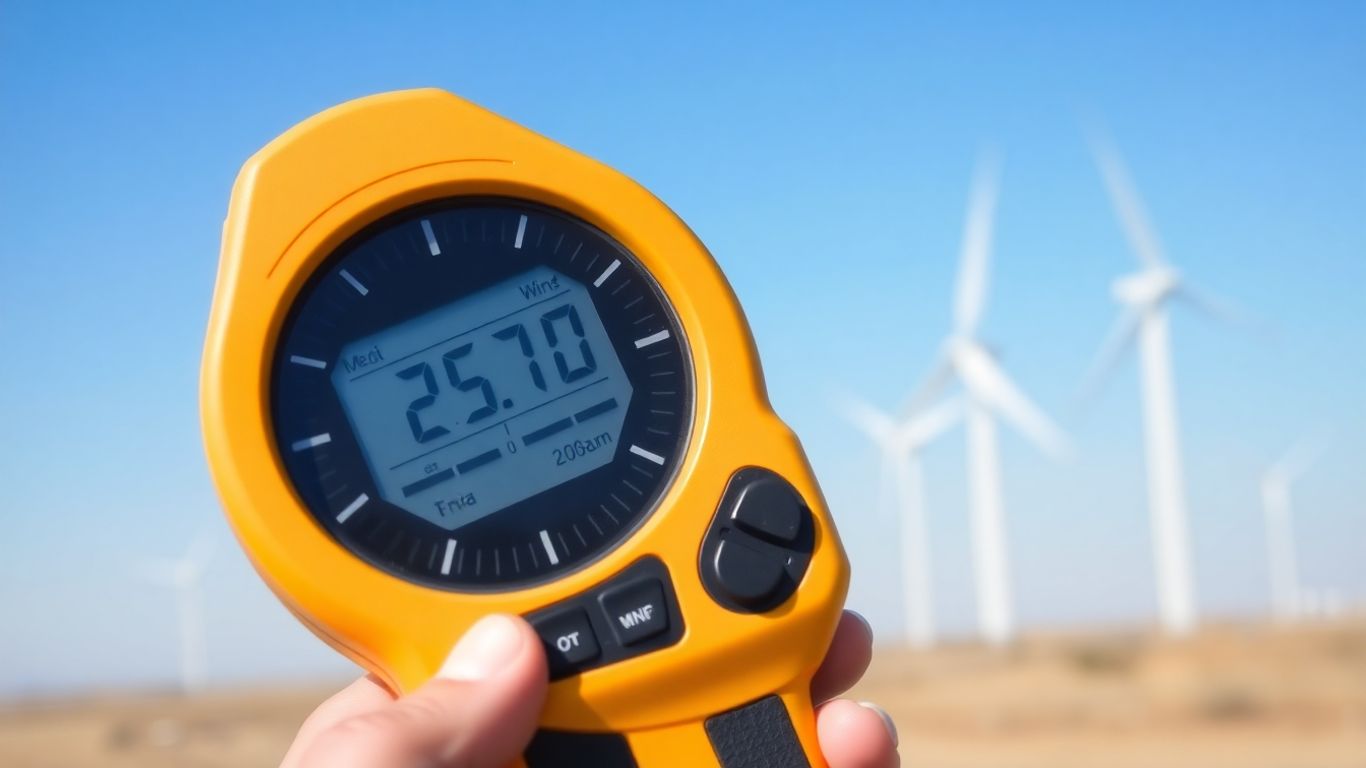
When you hear “anemometer”, it simply refers to an instrument designed to measure the wind. The word brings together two Greek roots: anemo, for wind, and meter, for measurement. Since the 18th century, the term has been used to name these instruments, which have become essential in many fields, such as meteorology, navigation, and aviation. A typical anemometer, such as a cup model, is now common on weather stations, fixed high up on a mast.
- The term has been used in the scientific world for centuries.
- There is a great variety of models suited to different purposes.
- The invention of these devices made reliable wind condition monitoring possible.
Choosing the right place to install an anemometer, for example ten metres above the ground according to meteorological standards, can make all the difference to the accuracy of the measurements.
Parameters measured by the anemometer
The anemometer is mainly used to record:
- Wind speed – This is its main function. This measurement can be instantaneous or recorded over time.
- The pressure exerted by the wind – Less common but also possible, depending on the type of device.
- Wind direction – Often associated with a weather vane, this gives a complete picture of air movements.
Here’s a simplified representation:
| Parameter | Main use |
|---|---|
| Wind speed | Weather forecasting, aviation |
| Wind pressure | Resistance calculations, engineering |
| Wind direction | Climate analysis, orientation |
Did you know? Some models, like the totalising anemometer, even record the distance travelled by the wind over a given time.
Differences between wind speed, pressure and direction
It’s important to distinguish between these three concepts, as they serve different purposes:
- Wind speed, typically expressed in metres per second (m/s) or kilometres per hour (km/h), only gives an idea of the horizontal movement of air.
- Pressure, often measured in pascals, indicates the impact force of the wind on a given surface. This can be used to estimate the loads experienced by buildings or sails.
- Finally, wind direction tells you where the air is coming from, which is essential for predicting weather changes or directing aircraft.
Each of these measurements can be taken individually or together, but it’s rare for a single device to provide all three simultaneously. For comprehensive observations, it’s sometimes necessary to use different instruments together.
The main types of anemometer and how they work
In this field, there are many ways to measure wind. You’ll quickly notice that each family of anemometer follows different logic and serves different uses. Your choice will depend as much on the measuring context as on the level of accuracy required. Let’s look at the most common types and how they work.
Cup anemometer and mechanical variants
One of the most well-known models, the cup anemometer, is easy to spot: three or four small cups are arranged around a vertical axis. The wind pushes these cups, and the device rotates faster or slower depending on wind strength. This rotational speed, converted to a linear speed, gives you an easy-to-read value. For some specific uses, you’ll also come across the plate anemometer, which works on a similar principle but with a flat surface.
Points to note:
- The direct mechanical contact makes these models reliable, but prolonged outdoor exposure requires regular maintenance.
- The measurement is limited to horizontal wind speed, with no information on direction unless a weather vane is attached.
- Can display in real time or accumulate the speed over a certain period using a counter.
Propeller, windmill and vane anemometers
Propeller anemometers look like miniature planes: a propeller mounted on a horizontal axis spins facing the wind. The system is often paired with a weather vane, meaning the instrument is automatically oriented into the airstream. Windmill anemometers have blades that rotate using a similar mechanism but measure speed on a specific plane.
For a proper reading, it’s important that the axis of the propeller is well aligned with the direction of the wind:
- Light, well-suited to mobile or temporary observations.
- Generally used by hobbyists or in agriculture for their ease of use.
- Some handheld models are very common for occasional use.
Pitot tube anemometers and pressure systems
This type is mainly for technical use, for example in aviation. A Pitot tube measures the dynamic pressure of the wind: the pressure in front of the tube’s opening (in the wind) is compared with the pressure at the side (out of the wind). This difference makes it possible to calculate wind speed precisely, particularly at high speeds.
| Feature | Main advantage | Main limitation |
|---|---|---|
| High accuracy | Precise measurements at high speed | Complex installation |
| No moving parts | Less mechanical wear | Requires calibration |
| Specific to aviation | Excellent for tubes and conduits | Not much use in general outdoor settings |
Ultrasonic and electronic technologies
Modern electronic models, especially ultrasonic types, measure wind speed using sound pulses sent between several sensors. The wind alters the travel time of the ultrasound between transmitter and receiver, which allows you to determine both speed and direction, even in three dimensions.
Advantages of these solutions:
- No exposed moving parts, so little wear.
- Accurate even at low speeds or during rapid variations.
- Compact, ideal for harsh or automated environments.
To get the most suitable measurement for your projects, it’s recommended to carefully consider the context in which you’ll use the anemometer. Some models favour reliability and simplicity, while others focus on accuracy or integration into electronic systems.
The units of measurement used by anemometers
Common units for wind speed
When you consult anemometer data, the first question is: in what unit is wind speed expressed? The standard unit you’ll see everywhere is metres per second (m/s). This is preferred for most scientific and technical measurements, as it simply shows how many metres the wind travels each second.
However, other units may appear depending on context or custom:
- Kilometres per hour (km/h): Commonly used in public weather bulletins.
- Knot (kn): Highly popular in aviation and marine settings.
- Feet per second (ft/s): Found in some Anglo-Saxon systems.
| Unit | Symbol | Equivalent in m/s |
|---|---|---|
| Metre/second | m/s | 1 m/s = 3.6 km/h |
| Kilometre/hour | km/h | 1 km/h = 0.28 m/s |
| Knot | kn | 1 kn = 0.514 m/s |
| Feet/second | ft/s | 1 ft/s ≈ 0.305 m/s |
When reading a measurement, always check the unit displayed on the device. This can help you avoid a lot of confusion, especially if you’re handling data from various sources.
Interpreting data and conversions
Wind speed readings are more useful when they can be compared or converted between units. For example, if you’re working in aviation, you’ll often need to convert km/h or m/s into knots.
To properly interpret the figures from your anemometer, keep in mind:
- There are simple conversion formulas:
- m/s × 3.6 = km/h
- m/s × 1.94 ≈ kn
- km/h ÷ 1.852 ≈ kn
- Modern home automation systems offer customisable displays (see systems with smart management), simplifying adjustments to suit your habits.
- Some anemometers offer direct multi-unit displays to avoid any error.
Importance of calibration for accuracy
One point not to overlook: calibrating your anemometer. Even the best device will give questionable results without regular calibration. Calibration means comparing your device’s measurements with a reliable reference under controlled conditions.
- Bear in mind that measurement errors may vary from one model to another.
- If you use the device for professional purposes, check when it was last inspected.
- A poorly calibrated anemometer gives false readings, which can affect your analysis or even safety in certain sectors.
Regular maintenance and checks will help you keep good reliability when measuring wind, whether for weather, agriculture or leisure.
Professional uses and application areas of the anemometer
In your work or studies on climate, the anemometer plays a central role. It allows you to note wind speed and sometimes direction accurately, which is vital for forecasting the weather and tracking atmospheric conditions. Meteorologists analyse wind measurements to anticipate storms, cyclones and climate changes.
- Forecasting severe weather events
- Study of the dispersion of atmospheric pollutants
- Monitoring extreme wind-related events
Reliable real-time wind measurement helps anticipate risky situations and tailor alerts for the public.
Use in aviation, marine and agricultural sectors
In these sectors, the anemometer is not a simple tool: it’s a safety and efficiency standard. On runways, on ships, or in fields, the portable or fixed anemometer guarantees decisions based on objective data.
| Sector | Main uses |
|---|---|
| Aviation | Local aerology control, safety for take-offs and landings |
| Marine | Navigation adjustment, route optimisation, maritime safety |
| Agriculture | Irrigation planning, controlled spraying, crop monitoring |
See how a portable anemometer measures wind speed and temperature to refine your own interventions in the field.
Role in industry, renewable energy and construction sectors
Wind has a direct impact on air quality, comfort, and productivity in industry or buildings. Thus, the anemometer becomes essential for:
- Managing industrial ventilation or air conditioning systems
- Maintenance and monitoring of wind turbines
- Securing building sites (evacuation in case of strong winds)
- Controlling airflow in closed spaces and tunnels
A well-used anemometer helps to reduce occupational risks and optimise the energy management of installations.
Whether you’re a technician, farmer or site manager, this instrument helps you tailor your practices as closely as possible to real needs and avoid the unexpected.
Choosing an anemometer according to your needs
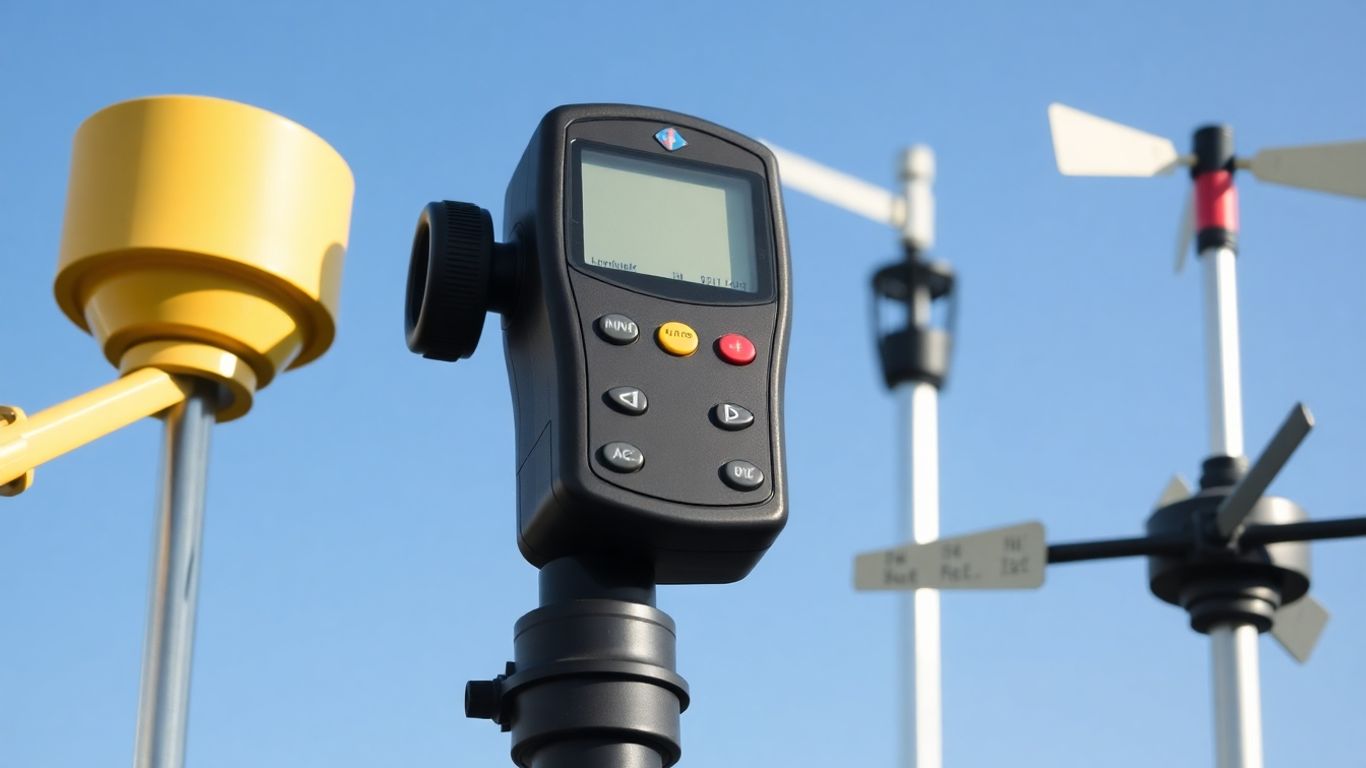
Finding the right anemometer isn’t that simple. It all depends on use, location and sometimes budget. There is no universal model, so it’s best to clarify how you’ll use it before making a decision. Defining your expectations is the first step to avoid unpleasant surprises.
Selection criteria for professional or domestic use
Before buying, ask yourself a few simple questions:
- Will the device be used for occasional or regular measurements?
- Do you need high accuracy or just an average wind estimate?
- Does the anemometer need to be weather-resistant or used indoors?
For professional use (agriculture, industry, meteorology), go for a calibrated device, with data memory and, if needed, able to connect to a weather station. For leisure, simplicity and portability are usually enough: a basic model can be sufficient. That’s why it’s useful to precisely identify your usage context before choosing, as explained in How to measure wind speed correctly.
Take time to analyse your environment and usage frequency. A high-end model isn’t necessary for everyone and some domestic models easily fit in your pocket.
Comparison between portable and fixed models
There are mainly two categories:
| Type | Advantages | Disadvantages |
|---|---|---|
| Portable | Lightweight, easy to carry, affordable price | Smaller measurement ranges, less accurate |
| Fixed (vanes or cups) | High accuracy, long-term storage, often possible connectivity | More complex installation, higher cost |
Fixed models are mainly suitable for permanent weather stations or industrial applications. Portable ones are useful everywhere: garden, hiking, outdoor sports.
Additional options and device connectivity
Options add value but can make the choice harder. Common features include:
- Bluetooth or Wi-Fi connection for display and storage on a smartphone
- Data series memory (useful for daily weather tracking)
- Additional sensors: temperature, humidity, rainfall
- Programmable alerts in case of gusts or sudden changes
While not essential, these options cater to specific needs: agricultural monitoring, long-term analysis, industrial site alerts, etc. In some cases, a simple but robust device is better. Always tailor the level of sophistication to your intended use.
Installation and best practice for using an anemometer
Properly installing an anemometer isn’t just about fixing the device. It also means choosing the right spot, ensuring connection to a weather station, and maintaining it regularly, even if maintenance is sometimes minimal.
Optimal placement for wind measurement
To get reliable readings, always place the anemometer in an open space, well away from any obstacles. A building, tree or even a hedge can affect the results. Ideally, aim for a height of at least 3 metres—many experts recommend 10 metres, but that’s not always possible for everyone. Install it on the roof if you can, otherwise in the middle of a field or beach depending on your context.
A few rules to remember:
- Always check there are no objects within 10 to 15 metres.
- Align the anemometer according to the manufacturer’s instructions (generally north/south).
- Make sure it’s perfectly horizontal using a level.
If the installation isn’t perfectly aligned, your readings will be incorrect, even with the best equipment.
Integration with a weather station
Connecting to a weather station (or smart home automation system, as in some devices offered by integrated multifunction sensors) is simple but should follow the manufacturer’s specific instructions. This starts with a wired or wireless connection, then data synchronisation. Remember to calibrate the device just after installation and, sometimes, after significant environmental changes.
Main steps to follow:
- Physically install the anemometer in the chosen spot.
- Connect cables or set up the wireless link.
- Run an initial calibration via the app or weather module.
- Test the readings and check they are consistent.
Maintenance and safety recommendations
Anemometer maintenance varies with technology. Most mechanical models need an annual clean, or even greasing or replacing worn parts like bearings. Ultrasonic models require less attention.
A few practical tips:
- Visually check your device two or three times a year.
- Remove any debris or foreign object that could block rotation.
- Check mounting and waterproofing after each major weather event.
- Install a lightning rod if the device is on the roof: lightning can quickly damage the electronics.
| Anemometer type | Maintenance frequency | Typical intervention |
|---|---|---|
| Cup/propeller | 1-2 times/year | Clean, check rotation |
| Ultrasonic | Once/year | Visual check, clean |
| Portable | Occasional | Batteries, clean surface |
Follow these practices to keep your anemometer working and get reliable results for many years. Remember, the lifespan of the device largely depends on the care you give it.
The anemometer in leisure and outdoor activities
An anemometer isn’t just for professionals. More and more outdoor enthusiasts equip themselves with an anemometer to maximise their safety and performance. Whether you enjoy water sports, mountain activities or you’re looking for accuracy in tracking your sporting performance, this instrument quickly proves essential.
Usefulness for water and aerial sports
For windsurfing, kitesurfing or free flight (paragliding, hang gliding), accurate wind measurements are a real asset. They determine if it’s possible to head out, ensure safety on the water or in the air, and affect the quality of your experience.
Some typical uses:
- Deciding if conditions are suitable to go out (wind strength matched to equipment)
- Adjusting your sail or board to match conditions
- Quickly estimating the on-site weather changes
It is common, when out and about, to compare different readings in a group depending on the area of the water or valley before taking off. Portable models thus fit perfectly with outdoor activities, just as some connected home safety devices are becoming common at home (autonomous alarm and sensors).
Measuring wind in mountain and agriculture activities
In the mountains, knowing the wind can make all the difference in planning an ascent, staying safe on a ridge, or organising a climbing event. Hikers and skiers also use it to anticipate gusty or bad weather situations.
For agriculture, the anemometer helps optimise spraying or irrigation. To avoid spray drift, for example, wind speed must be known and controlled.
Regular checks of wind strength protect not only your equipment but also people and the environment during agricultural or sporting activities.
Validation of sporting achievements and safety
In sport, especially athletics, a portable anemometer makes it possible to validate records for events like long jump or sprint. Why? Because above a certain limit, wind distorts the result.
Factors to be aware of for performance validation:
| Discipline | Allowed wind limit |
|---|---|
| Sprint (100m, 200m) | +2.0 m/s |
| Long/triple jump | +2.0 m/s |
Beyond this limit, the performance is not officially approved.
In short, mastering wind measurement during your outdoor activities means safer outings, wiser choices and improved safety for everyone.
Conclusion
To conclude, you can see that the anemometer is not just for specialists. Whether you’re a professional or a curious amateur, this tool is useful in many areas. There are several models, each with advantages, depending on your use. The measurement units are easy to understand, and installation or use doesn’t require special expertise. By choosing the right anemometer, you can easily monitor wind speed, whether for weather, sport, DIY or farming. Just take the time to define your needs before getting started, and you’ll find the anemometer will quickly become a practical everyday ally.
Frequently Asked Questions (FAQ)
What is an anemometer and what is it used for?
An anemometer is a device that measures wind speed. Depending on the model, it can also show wind direction and strength. It’s used to better understand the weather or for activities that depend on wind.
What are the different types of anemometer?
There are several types of anemometer: cup, propeller, vane, Pitot tube and electronic. They each work differently, but all measure wind. Some models are fixed, while others are portable.
What units are used to measure wind speed?
Wind speed is most often measured in kilometres per hour (km/h), metres per second (m/s) or knots (kt). Some devices also display speed in miles per hour (mph).
In what fields is an anemometer used?
An anemometer is used in meteorology, agriculture, aviation, marine, industry, construction and even for outdoor sports such as sailing or paragliding.
How do you properly install and use an anemometer?
You should place the anemometer high up, away from obstacles like trees or buildings. It should be securely fixed, especially if used on a roof or mast. Good maintenance and regular checks ensure reliable readings.
How do I choose an anemometer suited to my needs?
To choose an anemometer, consider how you’ll use it: professional or leisure, fixed or portable, simple or connected. Also think about ease of use, accuracy, and your preferred budget.
