
Choosing between centralised air conditioning and a VRF system is not always straightforward. You may find yourself hesitating, especially if you manage a large building or offices with differing needs depending on the area. Centralised air conditioning has been around for a long time and is still widely used, but the more recent VRF system also brings its own advantages. So, in which cases is it better to prioritise a centralised system? Here are the key points to remember to help you make the right choice.
Key points to remember
- Centralised air conditioning is ideal for large buildings where a uniform temperature is required throughout.
- It allows for simpler management of air quality and humidity, which is important in hospitals and shopping centres.
- Centralised systems are often more cost-effective on a large scale, especially if automation is well set up.
- Installation and maintenance can be more extensive and expensive than a VRF, particularly in older buildings.
- If you need to control temperature room by room or zone by zone, the VRF will often be better suited.
Definition and principles of centralised air conditioning
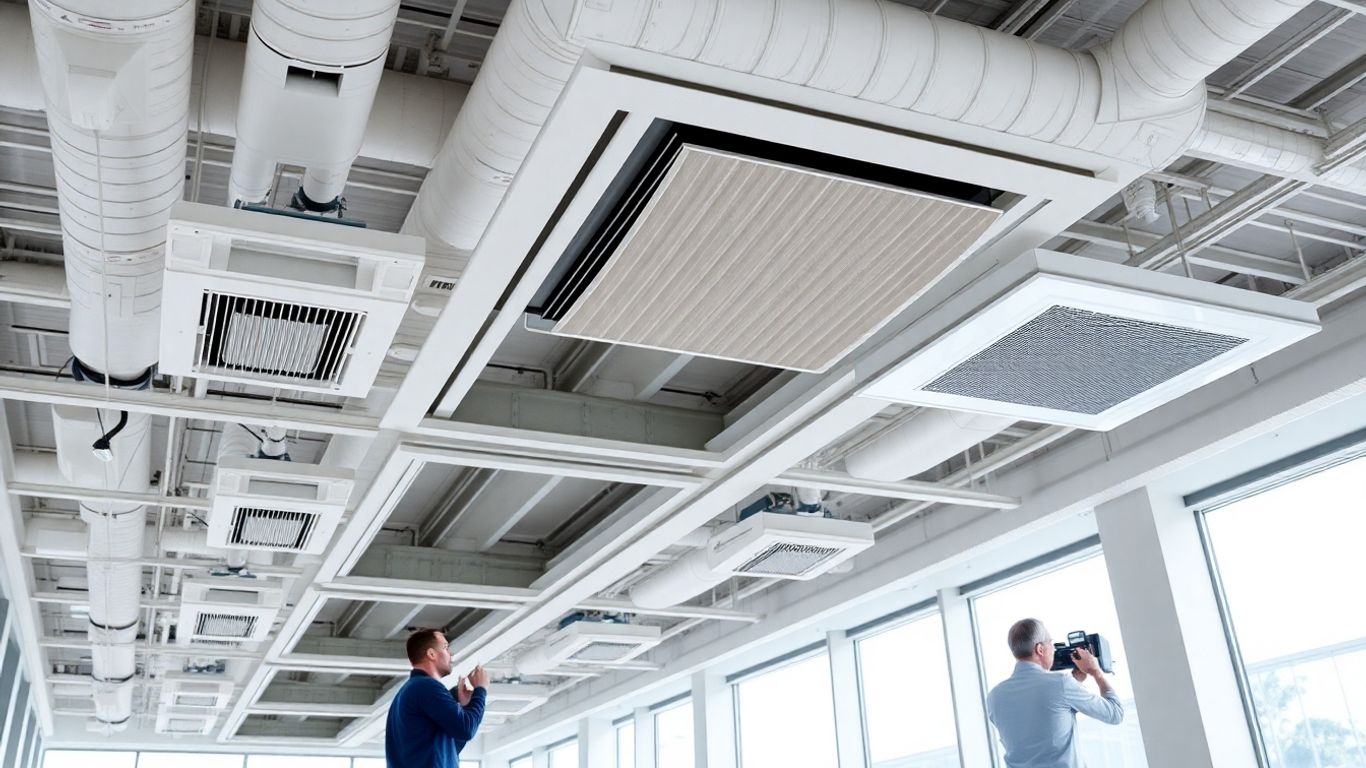
Centralised air conditioning provides a comprehensive solution for controlling temperature, humidity, and air quality throughout an entire building. This type of system draws its effectiveness from the fact that a main unit—often located in a plant room—feeds, via a network of ducts or pipes, different areas of the building. Centralising air treatment simplifies management and standardises comfort across rooms of varying sizes. If you want to compare this principle with other solutions, the precise definition of air conditioning can help clarify matters.
How a centralised system works
A centralised system is based on a few key steps:
- Outside air is drawn in, filtered, and treated by a main air handling unit.
- This air undergoes temperature adjustment by means of a heat exchanger, heating or cooling it as required.
- The treated air is then delivered to different rooms via a duct network, ensuring a uniform temperature.
- Finally, the air is either vented or recirculated depending on needs and the required air renewal rate.
For the user, this arrangement provides constant comfort, limiting the sensation of localised draughts or sudden temperature changes, which is often sought after in offices and large commercial spaces.
Managing air quality and humidity
Managing air quality is not limited to simply cooling. Humidity control, essential for a comfortable feel, is accounted for in several ways:
- Air filtration to remove dust and pollen.
- Automatic humidity control via a humidistat, which can activate humidification or dehumidification.
- Partial air renewal to comply with health standards and maintain an acceptable CO2 level.
| Function | Objective |
|---|---|
| Filtration | Remove particles |
| Controlled humidity | Prevent air from being too dry/humid |
| Air renewal | Maintain healthy air |
The role of HVAC engineering
HVAC engineering plays a central role: it designs, sizes, and improves installations according to building needs. Its involvement begins at the planning stage and extends into daily operation. It must coordinate the integration of different subsystems, ensure a balance between energy savings and ongoing comfort, and anticipate maintenance.
- Analysis of the building’s thermal and moisture loads.
- Selection of appropriate technologies.
- Supervision of settings and maintenance of long-term performance.
In practice, a good centralised system proves useful in premises requiring uniform treatment, where local reactivity or individual control is less crucial.
Specific advantages of centralised air conditioning
Thermal comfort and consistency of air distribution
With a centralised air conditioning system, you benefit from stable temperature in every space within the building. One of its main strengths is the consistent feel in each room, with no noticeable difference between areas that are far apart or exposed differently to the sun. This is particularly valuable for large buildings, where the effect of temperature variations can become a source of discomfort. Here’s what this type of system allows:
- Flexible and balanced distribution of cooling or heating
- Better control over unwelcome draughts
- Reduced discomfort caused by temperature jumps from room to room
Offering the same thermal sensation to each employee or resident is never straightforward; centralisation often meets this challenge better than dispersed solutions.
Energy management and potential savings
A well-sized centralised system allows you to optimise total energy consumption. The pooling of equipment and integrated automation encourages better hot-and-cold management, often limiting unnecessary waste. The potential gains depend on the building’s level of insulation as well as the adjustment of seasonal settings. Some usage scenarios remain more efficient than individualised systems.
| Criterion | Centralised system | Individual system |
|---|---|---|
| Electricity consumption | Moderate | Often high |
| Maintenance | Planned | Dispersed |
| Initial investment | Significant | Moderate |
Accurate programming, combined with occupancy detection systems, allows you to adjust operating times and reduce the energy bill, even though other solutions like VRF systems can offer greater savings in some cases.
Advanced automation and control functions
Another strength of centralised air conditioning is its ability to integrate with building controls. Modern systems offer:
- Remote control via tablet or smartphone
- Scheduling of air conditioning time slots
- Automatic regulation according to weather or occupancy rate
- Monitoring of temperature, humidity, and consumption data
These features allow for both precise adjustments and constant monitoring to prevent energy waste.
Centralisation makes technical management simpler and more reliable, as long as a supervisor (even remotely) manages maintenance and adjustment changes.
Limitations and constraints of centralised air conditioning
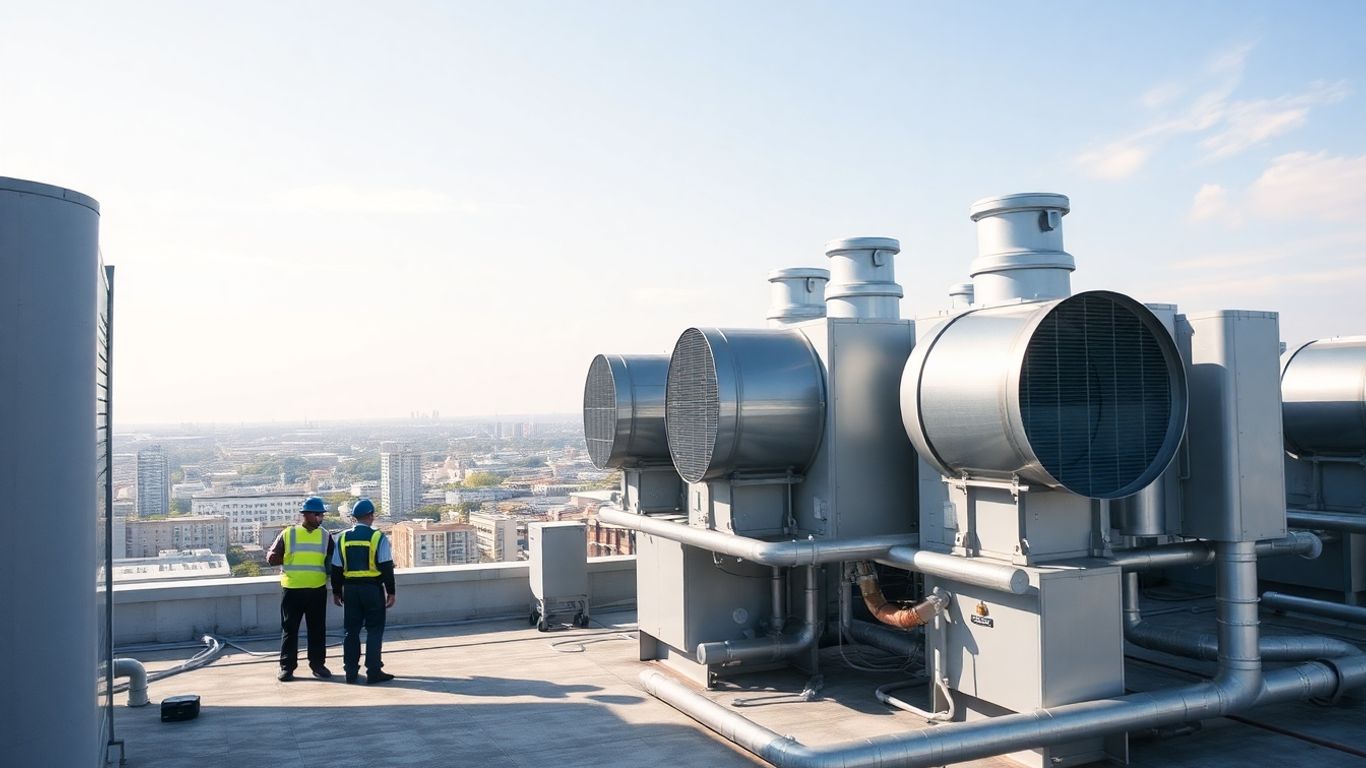
Even though centralised air conditioning provides a certain degree of comfort, it’s important to be aware of the restrictions before considering it. Several aspects impact its installation and daily operation.
Installation and maintenance constraints
- Centralised systems require extensive work during setup, especially in existing buildings.
- Regular servicing requires a professional intervention, which can be costly.
- Architectural constraints may limit feasible ductwork and air flow distribution.
- The smallest error in design or maintenance can affect performance across the entire building.
If you plan to renovate or extend your building, it’s best to consult an HVAC specialist to avoid nasty surprises later.
Energy consumption and environmental impact
- Central air conditioning plants are known for their significant electricity consumption, especially during heatwaves.
- They rely on refrigerants which, in the event of leaks or poor end-of-life handling, represent a major source of greenhouse gas emissions.
| Criterion | Impact |
|---|---|
| Electricity consumption | High, continuous |
| Refrigerants | Climate potential x2000 compared to CO₂ |
| Equipment servicing | Must be regular |
- Don’t forget noise from outdoor units, which can be disruptive in residential areas or for immediate neighbours.
Adaptability to seasonal changes in demand
- These systems sometimes struggle to manage changes between periods of high heat and mixed seasons.
- Fine regulation in each space is often less effective than with a VRF.
- In mid-season, there may be over-consumption or poor adaptation to rapid weather changes.
- You may lose out on bespoke adjustment, which directly affects comfort in little-used or variably occupied spaces.
Ultimately, centralisation offers an effective solution for large volumes, but is not the most flexible choice in environments with frequently changing needs.
Features and advantages of VRF systems
Principles of variable refrigerant flow
The VRF (Variable Refrigerant Flow) system is based on the idea of using only the exact amount of refrigerant needed at any moment in each zone to be treated. The compressor constantly adjusts the refrigerant flow sent through the network, allowing different rooms to be cooled or heated independently while optimising consumption. This is clearly different from standard central systems where all areas receive the same supply, regardless of occupancy or demand.
You can connect up to fifty indoor units to a single outdoor unit, which optimises integration in large or multi-purpose buildings.
Flexibility and modularity
With a VRF system, flexibility reaches an unrivalled level:
- Ability to set the temperature of each zone or room independently,
- Simple installation that avoids heavy and cumbersome ductwork,
- Easy expansion: add, remove, or replace indoor units without major changes,
- Variety of unit types to suit architectural requirements (cassette, wall-mounted, console, ducted).
This type of system genuinely supports different needs depending on how each space is used. Management is easy, via a central interface or individual controllers, often inspired by smart-home technology, as in certain modern home automation systems.
Energy efficiency in commercial settings
On the professional side, VRF performs very well in offices, hotels, or retail environments. Why? Because it reduces energy waste: only used areas are supplied. In both partial load and full load, the system continually adapts its power, reducing compressor wear.
In addition:
- Low pressure losses due to a simplified pipe network,
- Limiting peaks in electrical consumption,
- Possibility of simultaneous heating/cooling in some models (notably hybrid),
- Reduced refrigerant quantity needed, especially in hybrid VRFs, lowering environmental impact.
| Key advantage | VRF systems | Centralised air conditioning |
|---|---|---|
| Zone-by-zone control | Yes | Limited or absent |
| Modularity | Very high | Moderate to low |
| Number of units | Up to 50 | Generally limited |
| Partial load efficiency | Optimised | Variable |
Installing a VRF is an effective way to respond to changing occupancy in commercial spaces and to optimise medium-term energy costs.
Keep in mind that today’s VRF systems continue to evolve, benefiting from the integration of smart controls and adapting to energy saving requirements without sacrificing individual comfort.
Key criteria for choosing between centralised air conditioning and VRF
When you have to choose between centralised air conditioning and a VRF (Variable Refrigerant Flow) system, several factors can influence your decision. This choice is never neutral: it depends on the building’s layout, your control requirements, and the total project budget.
Surface area and building configuration
The nature and size of the area to be treated play an important role in the choice of system. Are you managing a large commercial complex, a shared office, or a hospital? Here are some points to keep in mind:
- Centralised installations are better suited to large, uniform spaces where even air distribution is key.
- VRF systems are favoured in buildings with different-sized zones or varied needs from one area to another.
- Modularity: VRF can be extended gradually, each indoor unit being adaptable without having to start over.
Here’s a little comparison table:
| Criterion | Centralised | VRF |
|---|---|---|
| Minimum project size | Large | Medium to large |
| Room-by-room modulation | Limited | Very easy |
| Easy expansion/adaptation | No | Yes |
Importance of individualised control within zones
In some buildings, it becomes essential to precisely adjust the temperature in each zone. If you want to give each occupant the freedom to choose their own temperature, VRF provides far greater flexibility. This is crucial for spaces like:
- Shared offices where needs vary by occupancy.
- Hotels or healthcare settings requiring personalised comfort.
- Sites where individual management protocols are essential, as in some home automation protocols.
Investment and operating budget
At first glance, centralised installation requires a fairly high upfront budget, mainly for the ductwork and machinery. However, VRF, while more flexible, can be surprisingly costly to buy for very large surfaces.
- Centralised: high fixed cost, conventional servicing, optimised for global use.
- VRF: evolving investment, specialist servicing, easy adaptation for changing use.
- Energy usage varies by occupancy: a VRF can be advantageous in partial use thanks to its modulation.
If the project size is limited, the required flexibility is very high or building modification is likely, it will often be more relevant to choose VRF. On the other hand, for a large, uniform, stable site, the centralised solution remains coherent.
Ultimately, a good understanding of current layout, anticipating future needs, and balancing cost, scalability, and simplicity will help you choose between these two technologies.
Requirements of modern buildings and example applications
In today’s context, your buildings require reliable solutions to maintain optimum comfort and meet increasingly exacting constraints. Spatial complexity, user diversity, and the pursuit of energy efficiency determine the choice between a centralised air conditioning system or VRF. Let’s see how these requirements translate according to the different types of buildings and areas of use.
Needs of large infrastructures like shopping centres
Shopping centres welcome huge numbers of visitors daily. Their needs include:
- Uniform temperature across very large surfaces.
- Flexible management of several zones with variable occupancy (shops, communal areas, food courts).
- Quick response to changes in footfall or opening hours.
- A central interface to manage heating, cooling, and ventilation.
Centralised automation is ideal here, allowing intelligent equipment synchronisation – as highlighted by easy management via a single interface.
For a multi-level centre, maintaining temperature consistency soon becomes a priority, but you must also manage temperature spikes at peak times without blowing up the energy bill.
Comfort management in healthcare buildings
Hospitals and clinics often create even stricter constraints:
- Strict climate separation between each sector (operating theatre, room, lobby).
- Complete control over humidity and air quality.
- Redundancy and system security to ensure comfort even in case of failure.
In these settings, a centralised system coupled with local regulators is often what you’ll find: it guarantees cleanliness of air, thermal stability, and constant sanitary monitoring.
| Requirement | Centralised system | VRF |
|---|---|---|
| Air filtration | Very high | Moderate |
| Room/peak control | Possible | Excellent |
| Maintenance | Delicate | Simple |
Examples of offices with centralised regulation
In the commercial sector, office floors often have widely varying demands according to hours and usage:
- Automatic temperature control according to occupancy.
- Custom settings by zone or floor.
- Integration with connected systems to optimise consumption and comfort.
Thus, modern setups often favour a centralised smart-home approach, integrated with other building equipment to maximise both energy performance and user satisfaction.
Analysing your building, how it is used, and health or safety requirements are key factors in guiding your choice. Take time to assess each criterion so you can choose a suitable and long-term solution.
Environmental impacts and energy challenges
You face several questions when installing centralised air conditioning. First, energy. Then, environmental impact. And finally, the growing pressure to reduce greenhouse gas emissions. To take stock, it is important to look closely at each issue.
Electricity consumption on a global and local scale
The widespread use of air conditioning, centralised or not, represents a huge part of electricity demand, especially during heatwaves. For instance, in some countries, up to 70% of electricity can be used for thermal comfort in buildings during summer. This creates several challenges:
- Managing consumption peaks, often during heatwaves
- Sizing of electrical grids and power stations
- Risk of overload and local blackouts
- Operating costs for property managers
| Type of building | Proportion of electricity consumption dedicated to air conditioning |
|---|---|
| Modern offices | 35% |
| Shopping centres | 40% |
| Healthcare buildings | 25% |
If you fail to consider these aspects, your energy bill will rise quickly – and your local electricity supply can become unstable.
Associated greenhouse gas emissions
A significant proportion of the world’s electricity is still produced from fossil fuels. The result: every kilowatt hour used for centralised air conditioning results in CO2 being emitted into the atmosphere, along with other greenhouse gases. Centralised systems can generate high indirect emissions if the electricity is not from sustainable sources.
Key points to monitor:
- Emissions from electricity production
- Possible refrigerant leaks (high global warming potential)
- Equipment lifespan and end-of-life recycling
Ways to limit the carbon footprint of centralised systems
Fortunately, you have levers to reduce the ecological impact of centralised systems. A proactive policy can rely on different strategies:
- High-performance, labelled, and appropriately sized equipment
- Choosing renewable energy sources for supply
- Regular maintenance to avoid losses and leaks
- Optimising settings and using automation
- "Low-tech" complementary approaches (shading, green roofs, best practices)
As with other sectors’ source-reduction strategies, such as the plan adopted at Toulouse Jean Jaurès University, rigorous management and rethinking usage itself can achieve strong results without sacrificing occupant comfort.
Finally, remember that every improvement in the energy efficiency of a centralised system benefits a company’s finances all year round, as well as the planet.
Conclusion
To sum up, there is no universal answer between centralised air conditioning and the VRF system. Each option has its advantages and its limits. If you manage a large building, need constant comfort, and want centralised control, centralised air conditioning is often the simplest and most reliable choice. Conversely, for spaces where flexibility, scalability, or independent zone management are important, VRF is an attractive alternative. It is therefore essential to clearly define your priorities, the layout of your premises, and your energy consumption expectations before deciding. Don’t hesitate to consult a professional to assess the most suitable solution for your situation. In the end, the right choice is the one that best meets your daily needs while staying in line with your budget and technical constraints.
Frequently Asked Questions
What is a centralised air conditioning system?
A centralised air conditioning system is a set of devices that cools or heats the air in several rooms at once from a central point. The air is distributed throughout the building via ducts. This system keeps a stable and comfortable temperature in all areas.
What are the advantages of centralised air conditioning compared to VRF?
Centralised air conditioning offers uniform comfort throughout the building. It also allows better control of air quality and humidity. In addition, it is often easier to manage in large spaces, as everything is controlled from a single point.
When is it better to choose a VRF system?
The VRF (Variable Refrigerant Flow) system is advisable if you want to control the temperature of each room separately. It is also ideal for buildings with different needs in different zones, such as offices or hotels. VRF is modular and can be installed gradually.
Does centralised air conditioning use more energy than VRF?
Centralised air conditioning can use more electricity, especially if the building is not well insulated or all zones are not used at the same time. VRF systems, on the other hand, adjust their power according to actual needs, which often results in energy savings.
Which system is easier to maintain: centralised or VRF?
Centralised systems often require more maintenance, as they have many ducts and one large main unit. VRF is easier to maintain, because each indoor unit can be checked separately, and there are fewer large installations to watch over.
What is the environmental impact of centralised air conditioning?
Centralised air conditioning can have a major environmental impact due to its energy consumption and the gases used. To limit this, it is advisable to insulate the building well, schedule the air conditioning, and use modern systems that use less and emit fewer harmful gases.
