
Are you considering installing reversible air conditioning to improve the comfort of your home, summer and winter? That’s an excellent idea, as this appliance is renowned for its energy efficiency. But concretely, how does it work and what is its actual electricity consumption? This article will shed light on how reversible air conditioning works, help you estimate its consumption, and give you tips for controlling your expenses.
Key Points to Remember
- Reversible air conditioning works like an air-to-air heat pump, capable of heating in winter by capturing outdoor heat and cooling in summer by expelling heat outwards.
- Its electricity consumption is generally lower than that of traditional heating systems, as it produces more energy than it consumes (thanks to its Coefficient of Performance – COP).
- Several factors influence its consumption: the appliance’s power, the quality of your home’s insulation, your region, and how you use it.
- To reduce consumption, opt for appliances with a high COP, adjust the temperature (avoid extremes), use programming, and ensure regular maintenance.
- Estimating the cost of use involves knowing the compressor’s power and the price of your electricity kWh, then calculating for a given use.
Understanding how reversible air conditioning works
A 2-in-1 system for thermal comfort
Reversible air conditioning, often called an air-to-air heat pump, is a versatile appliance designed to regulate the temperature of your home throughout the year. Its operating principle is based on its ability to transfer heat from one place to another. In summer, it captures heat from inside your home and expels it outside, providing you with a feeling of coolness. Conversely, in winter, it captures heat present in the outdoor air, even in cold weather, to diffuse it indoors, ensuring your thermal comfort. This dual functionality makes it an economical and ecological solution for maintaining a pleasant temperature, summer and winter.
The role of refrigerant fluid in heat exchange
At the heart of the reversible air conditioning system is the refrigerant fluid. This special liquid circulates in a closed circuit and undergoes changes of state (liquid/gaseous) that allow it to absorb or release heat. In cooling mode, it absorbs heat from the indoor air, vaporises, then is compressed to release this heat outdoors. In heating mode, the process is reversed: the fluid absorbs heat from the outdoor air, vaporises, then is compressed to diffuse this heat indoors. It is this ability to change state that makes heat transfer possible, much like the refrigerant in your refrigerator, but with the ability to reverse the cycle. The efficiency of this transfer is a key factor for the appliance’s energy performance. You can find information on different types of systems and their characteristics on platforms dedicated to the smart home.
Circuit reversal for heating mode
The characteristic
Assessing the electricity consumption of a reversible air conditioner
It’s not always easy to know precisely how much your reversible air conditioning consumes. Indeed, several factors come into play and can vary this consumption. Understanding these factors will help you better control your energy costs.
Factors influencing energy consumption
The consumption of a reversible air conditioner depends on several things. Firstly, the appliance model plays an important role; some are more economical than others. The power of the appliance is also a key criterion: a machine that is too powerful for your home will consume unnecessarily. The external environment, such as the ambient temperature and the climatic zone where you live, also influences operation. Let’s not forget the characteristics of your home: good wall and roof insulation, the quality of the windows, and even your home’s exposure to the sun can have a significant impact. Finally, your personal usage, i.e., the frequency and duration of use, as well as the temperatures you set, are decisive.
Estimating hourly and annual consumption
To get an idea of consumption, it’s important to know that the power absorbed by an air conditioner can vary. For an estimate, we can base it on the nominal power. For example, a 2500-watt appliance will consume approximately 2.5 kWh per hour when operating at full power. The hourly cost will then depend on the price of your kilowatt-hour (kWh). It is possible to calculate annual consumption by multiplying the hourly consumption by the number of hours of use per day, then by the number of days of use in the year. Remember that inverter systems adjust their consumption in real time, which makes exact calculations more complex, but generally more advantageous. To give you a rough idea, an appliance can cost between €0.38 and €0.63 per hour of use, depending on the models and the electricity tariff [9c31].
Comparison with traditional heating systems
Compared to other electric, gas, or oil heating systems, reversible air conditioning is often more economical. It can consume up to 40% less energy. This is partly explained by its Coefficient of Performance (COP). A COP of 3, for example, means that for every 1 kWh of electricity consumed, the appliance produces 3 kWh of heat. In heating mode, some models can even reach a COP of 4, producing 4 kWh of heat for 1 kWh of electricity. This is a considerable advantage for reducing your bills.
It is important to note that consumption can be higher during the initial temperature setting of a room, compared to maintaining that temperature. Inverter systems adjust their power to maintain the desired temperature, which is more efficient over time.
To better estimate your consumption, you can use online calculators or consult your appliance’s technical data. It is also useful to compare your electricity bills over several years to identify any unusual increases that could indicate a problem with your equipment [c83e]. Regular maintenance is also recommended to maintain your appliance’s efficiency and avoid excessive consumption.
Optimising use to reduce costs
To control your electricity consumption with reversible air conditioning, several strategies can be implemented. This involves adopting sensible habits and properly configuring your appliance so that it operates optimally.
The importance of temperature regulation
How you set your air conditioner’s temperature has a direct impact on its consumption. It is advisable not to overemphasise the difference between indoor and outdoor temperatures. For example, in summer, aim for an indoor temperature that is no more than 5 to 7 degrees lower than the outdoor temperature. In winter, avoid overheating. Too extreme a setting puts more strain on the compressor and increases consumption.
Programming and thermostat use
Using a programmable thermostat or a home automation system can greatly help optimise your air conditioning usage. These devices allow you to define operating time slots and specific temperatures for each time of day. For example, you can programme the appliance to switch off during hours when you are not present or when the outdoor temperature is favourable for natural ventilation. This avoids unnecessary operation of the appliance and significantly reduces consumption. Installing a smart thermostat can help you manage your consumption remotely, for example by anticipating needs or adjusting settings according to the weather [9132].
The benefits of good home insulation
Good insulation of your home is a determining factor in reducing your reversible air conditioning’s consumption. A well-insulated home retains coolness better in summer and heat in winter, which reduces the demand on the appliance. Less heat loss means your air conditioner doesn’t need to operate continuously to maintain the desired temperature. Remember to check the sealing of your windows and doors, and to insulate your attic and walls if necessary. This contributes to better overall energy efficiency for your home [9427].
Keys to controlled consumption
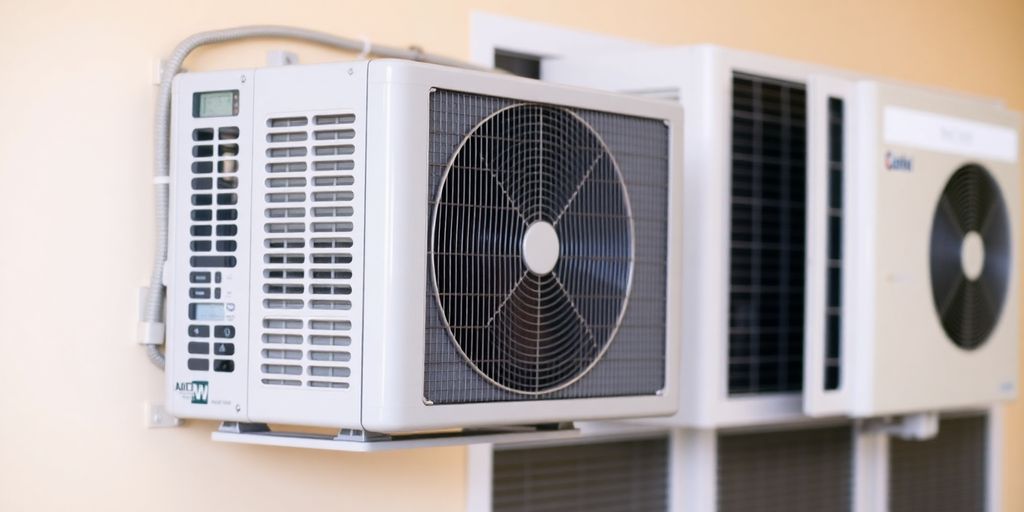
To control your reversible air conditioning’s consumption, several levers are available to you. This involves making informed choices when purchasing and adopting good daily habits.
Choose an appliance with a high coefficient of performance
The Coefficient of Performance (COP) and Seasonal Coefficient of Performance (SCOP) are key indicators of your appliance’s energy efficiency. A high COP means your air conditioner produces more heat or cold for every watt of electricity consumed. Therefore, opt for the most efficient appliances, often identified by an energy class A++ or A+++. These models, although they may represent a slightly higher initial investment, will lead to substantial long-term savings.
The impact of power and appliance size
Choosing the right power for your air conditioning is essential. An undersized appliance will constantly struggle to reach the desired temperature, thus increasing its consumption. Conversely, an oversized appliance will operate intermittently, which is also less efficient and can prematurely wear out the compressor. Therefore, you need to adapt the power to the size of the room or home to be air-conditioned, taking into account insulation, ceiling height, and the number of windows. A general rule suggests around 100 to 130 watts per square metre for a standard ceiling height.
Regular maintenance to maintain efficiency
Regular maintenance is essential to ensure the proper functioning and energy efficiency of your reversible air conditioning. Dust accumulated on the filters and in the units can reduce airflow and force the appliance to work harder, increasing electricity consumption. Cleaning the filters every 15 days or a month, depending on use, is highly recommended. Furthermore, an annual check by a professional allows for verification of the refrigeration circuit and ensures that everything is operating optimally. This can prevent costly breakdowns and maintain the performance of your equipment, as suggested by recommendations for the maintenance of heat pumps.
Good management of your appliance also involves smart use. Remember to programme operating time slots adapted to your actual needs and to adjust the set temperature. Avoid too significant differences between indoor and outdoor temperatures; a 5°C differential is generally sufficient for optimal comfort without overconsuming.
Calculating the cost of using your appliance
To effectively control your budget, it is essential to understand how your reversible air conditioning’s electricity consumption is calculated. This will allow you to anticipate expenses and optimise its use.
Identify the compressor’s power
The first step is to know the exact power of your appliance. You should not rely solely on the air conditioner’s nominal power, but rather on that of the compressor. This information is usually found in your equipment’s technical documentation. Higher power logically means higher consumption.
Find out about the kWh price
The cost of electricity varies depending on your supplier and the type of contract you have. It is therefore essential to know the price of your kilowatt-hour (kWh). You will find this information on your electricity bills. Remember to take into account different tariffs (peak hours, off-peak hours) if your contract offers them.
Calculation method to estimate the hourly cost
Once you have these two elements, the calculation is quite simple. You just need to multiply the compressor’s power (expressed in kilowatts) by the price of your kWh. The result will give you an estimate of the cost for one hour of operation of your air conditioning.
For example, if your compressor has a power of 1.5 kW and your kWh costs €0.20, the hourly cost will be 1.5 kW * €0.20/kWh = €0.30.
It is important to note that this estimate is an average. Actual consumption may vary depending on the outdoor temperature, the indoor temperature setting, and your home’s insulation. For a 100m² air conditioning system, a power of approximately 10 kW may be necessary, which translates to a consumption of approximately 10 kWh per hour of use [93d1].
Here is a summary table to help you visualise:
| Compressor Power (kW) | kWh Price (€) | Estimated Hourly Cost (€) |
|---|---|---|
| 1.0 | 0.18 | 0.18 |
| 1.5 | 0.20 | 0.30 |
| 2.0 | 0.22 | 0.44 |
To obtain an annual estimate, multiply this hourly cost by the number of planned hours of use over the year. Remember to adjust this calculation according to the seasons and your specific needs.
Practical tips for reduced electricity consumption
To control your electricity consumption with your reversible air conditioning, several simple actions and sensible choices can make a real difference to your bill. This involves adopting good habits so that your appliance operates optimally.
Opt for a high-performance energy class
When choosing your appliance, prioritise those with a high energy class, ideally A+++. The closer the rating is to this designation, the more the equipment is designed to consume little electricity while offering good efficiency. This is an initial investment that translates into long-term savings.
Adapt the system’s power to your needs
The power of your air conditioner must match the size of the rooms you wish to heat or cool. An undersized appliance will struggle and consume more to reach the desired temperature, without fully achieving it. Conversely, an oversized appliance will operate intermittently and will be no more economical. It is often advisable to allow between 100 and 130 watts per square metre for a standard ceiling height.
Adopt simple daily habits
- Set the temperature wisely: Avoid too significant differences between indoor and outdoor temperatures. A 5°C difference is generally recommended. In winter, don’t overheat, and in summer, don’t go too low.
- Use programming: If your appliance allows it, programme it to operate only when necessary. For example, turn it off when you leave your home or lower the temperature during the night. You can even programme the shutdown of your air conditioner during the coolest hours in summer to benefit from natural ventilation.
- Maintain your appliance: A clean filter is essential. A clogged filter can increase your air conditioner’s electricity consumption by up to 30%. Clean it regularly, at least three times a year, or call a professional for annual maintenance. This ensures not only better efficiency, but also better air quality.
- Ensure good insulation: Good insulation of your home (walls, attic, windows) limits heat loss in winter and heat gain in summer. This reduces the demand on your air conditioning and, consequently, its consumption.
By following these tips, you will optimise the use of your reversible air conditioning and significantly reduce your electricity consumption.
In summary: a wise investment for your comfort
As you will have understood, reversible air conditioning, often called an air-to-air heat pump, represents an interesting solution for managing the temperature of your home throughout the year. Although it consumes electricity, its energy efficiency is notable, especially compared to older heating systems. By adopting a few good practices, such as regular maintenance, sensible use, and good insulation of your home, you will maximise its benefits and control your consumption. It is a choice that can truly contribute to your thermal comfort while being more respectful of your energy budget in the long term.
Frequently Asked Questions
How does a reversible air conditioner work?
A reversible air conditioner is like a magic appliance that can do two things: cool your home when it’s hot and heat it when it’s cold. It uses a special liquid that circulates in pipes to take heat from outside and put it inside, or vice versa. That’s why it’s also called an air-to-air heat pump.
Does a reversible air conditioner consume a lot of electricity?
Electricity consumption depends on several things: the size of the appliance, its power, if it’s well adjusted, and if your home is well insulated. But in general, it’s quite an economical appliance compared to older electric heaters.
How can I use my reversible air conditioner to consume less?
To consume less, you need to set the temperature correctly: not to overheat in winter and not to overcool in summer. Installing a thermostat that programmes temperatures helps a lot. Also, remember to properly insulate your home so that heat or coolness doesn’t escape.
How do I calculate the cost of using my reversible air conditioner?
To find out how much it consumes, look at the appliance’s power (often indicated on the compressor) and the price of electricity at your home. Multiply these two figures to get an idea of the cost per hour. For example, a 2500-watt appliance consumes approximately 2.5 kWh per hour.
Should I have my reversible air conditioner maintained?
Yes, it is advisable to have your appliance maintained regularly, once a year or every two years. This ensures that it functions well and doesn’t consume more than necessary. It’s also important for the warranty to be valid.
Should I turn my reversible air conditioner on and off frequently?
It is preferable not to turn the appliance on and off too often. When you turn it on, it consumes more energy to reach the correct temperature. It’s better to let it operate at a stable temperature or to use a thermostat to programme it.
